Namibia is targeting an increase in the contribution of secondary industries to 25% of Gross Domestic Product (GDP) by 2030, as the government pushes to expand manufacturing and reduce the country’s reliance on raw material exports.
Under the Sixth National Development Plan (NDP6), manufacturing is expected to account for 18% of GDP by 2030, while manufactured products are targeted to reach 60% of total goods exports.
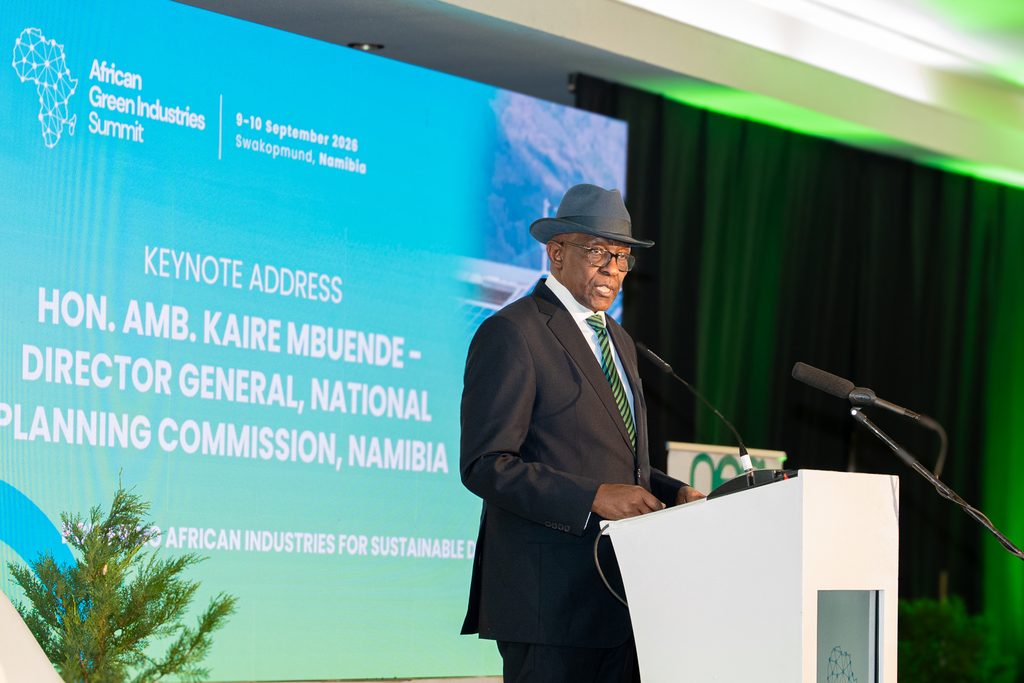
National Planning Commission (NPC) Director-General and Green Industries Council Chairperson Kaire Mbuende said the targets form part of Namibia’s drive to process more of its natural resources locally and build industries capable of supplying domestic, regional and international markets.
Speaking at the African Green Industries Summit 2026 in Swakopmund, Mbuende said green hydrogen is being positioned as an enabler of the wider industrialisation programme rather than an industry focused solely on hydrogen production and exports.
“The issue before us is therefore no longer only how much green hydrogen we can produce. It is what we can manufacture with it, the minerals we can beneficiate, the industries we can decarbonise, and the infrastructure we can develop,” Mbuende said.
“At the end of the day, it is a question of how many Namibian businesses and workers can participate in the resulting value chains.”
Namibia has set a target of producing 1.3 million tonnes of green ammonia annually by 2030, alongside two million tonnes of direct-reduced iron and 143 GWh of green baseload electricity.
The country is also targeting 30,000 green hydrogen-related jobs and 30% local content and participation by the end of the decade.
Mbuende said the targets are intended to stimulate downstream industries rather than simply increase production volumes.
“These are not simply production targets. They are about building value chains,” he said.
He cited HyIron Oshivela as an example of using renewable energy and green hydrogen for low-carbon iron production, while the Daures Green Hydrogen Village is being used to demonstrate potential applications in agriculture, fertiliser production, skills development and rural enterprise.
Namibia is also seeking access to up to US$250 million in concessional finance for green industrialisation and the decarbonisation of hard-to-abate industries through its Sectoral Transformation Investment Plan under the Climate Investment Funds Industry Decarbonization Programme.
Mbuende said the financing would be used to develop a pipeline of projects capable of supporting the country’s industrialisation ambitions.
The NPC is meanwhile advancing the Green Industrialisation Policy as part of efforts to establish a coordinated policy and institutional framework for emerging green industries.
Government is also undertaking Strategic Environmental and Social Assessments in Namibia’s green hydrogen valleys to assess the cumulative environmental and social impacts of proposed developments and identify areas where projects can proceed, require mitigation measures or should be avoided.
Skills development is being pursued through the Youth for Green Hydrogen Scholarship Programme, which is training Namibians in technical fields linked to emerging green industries.
Mbuende said achieving the 2030 industrialisation targets will require investment across electricity generation, transmission, mineral beneficiation, manufacturing, ports, rail, finance and market access.
Local content, skills development and environmental, social and governance requirements will also have to be incorporated into the expansion of the sector, he said.
“Namibia has the renewable energy potential, mineral resources, strategic ports, land and market access required to become a competitive green industrial economy,” Mbuende said.
“The task before us is to retain more value from these resources by processing, manufacturing and building businesses around them.”