Namibia wants its emerging petroleum industry to drive industrialisation and create opportunities across the wider economy rather than develop into an isolated sector focused mainly on exporting crude oil, Vice President Lucia Witbooi has said.
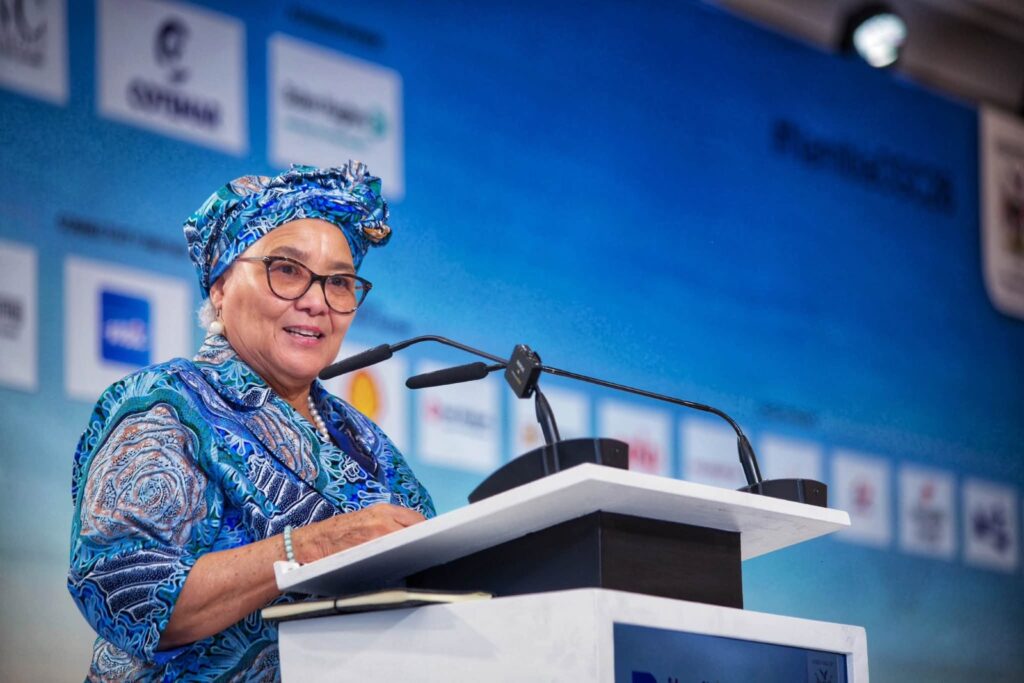
Speaking at the official opening of the Namibia Oil and Gas Conference 2026 in Windhoek on Wednesday, Witbooi said the country must use petroleum development to build domestic industries, businesses and skills that can continue generating economic value beyond the lifespan of its oil resources.
“Petroleum must not become an enclave industry operating alongside the Namibian economy. It must become a catalyst for diversification, industrialisation and enterprise development,” Witbooi said.
She identified ports, logistics, fabrication, engineering, marine services, storage, manufacturing, financial services and information technology among sectors that could benefit from the development of Namibia’s offshore petroleum industry.
The approach comes as major discoveries, including Venus and Mopane in the Orange Basin, move Namibia closer to possible oil production and raise questions over how much of the economic activity generated by the sector will remain in the country.
Witbooi said government’s objective extends beyond achieving first oil, with petroleum expected to create jobs, strengthen local businesses and support infrastructure and industrial development.
“The real dividend must be reflected in jobs, stronger Namibian businesses, improved infrastructure, technology transfer, skills development, increased government revenues, industrial growth and improved opportunities for future generations,” she said.
Government is also advancing the National Upstream Petroleum Local Content Policy, which seeks to increase Namibian participation through employment, procurement, enterprise development, ownership, financing and technology and knowledge transfer.
However, Witbooi stressed that local participation must be commercially sustainable and supported by Namibian companies and professionals capable of meeting international oil and gas industry standards.
The Presidency also wants future petroleum revenues converted into long-term productive and financial assets rather than used mainly to increase government consumption.
“Petroleum revenue must not be treated as an invitation to consume more today at the expense of tomorrow,” Witbooi said.
“We must use a portion of resource income to strengthen public finances, support productive investment and preserve wealth for future generations. Fiscal discipline will be as important as fiscal revenue.”
The Welwitschia Sovereign Wealth Fund forms part of government’s framework for preserving resource wealth, while Witbooi said institutions, reporting systems and accountability mechanisms would have to be strengthened as the country moves towards potential production.
“Our ambition is not simply to become an oil-producing country. Our ambition is to become a country that uses the petroleum opportunity intelligently to accelerate economic transformation,” she said.
Witbooi said the longer-term test would be whether Namibia’s petroleum industry leaves behind viable businesses, infrastructure, technical capabilities, stronger institutions and financial assets that continue benefiting the economy after the country’s finite petroleum resources are depleted.