The Namibian government has allocated N$17.5 million to a Local Content Plan expected to create about 470 direct jobs across the country’s film and television industry.
The funding forms part of a broader N$50 million allocation towards creative industries programmes and will finance a national soap opera, two limited television series, 14 regional short films and an equipment access programme.
Minister of Education, Innovation, Youth, Sports, Arts and Culture Sanet Steenkamp said the programme is aimed at supporting local productions while creating employment, developing skills and building businesses within the creative sector.
“Our objective is therefore not only to support content production, but to strengthen a broader creative ecosystem in which Namibians can develop skills, gain experience, create businesses and build sustainable livelihoods,” Steenkamp said.
Of the N$17.5 million allocation, N$8.64 million will fund production of a national soap opera, while N$3.38 million will go towards two limited television series.
A further N$3.5 million has been allocated to short film production across Namibia’s 14 regions, while N$1.73 million will fund an Equipment Access and Management Programme. Another N$250,000 has been set aside for administration, marketing and implementation.
Steenkamp said the investment is expected to create opportunities for writers, actors, directors, producers, cinematographers, editors, sound technicians, designers and production crews.
“The investment is expected to create approximately 470 direct employment opportunities, while benefiting many more people indirectly across the creative value chain,” she said.
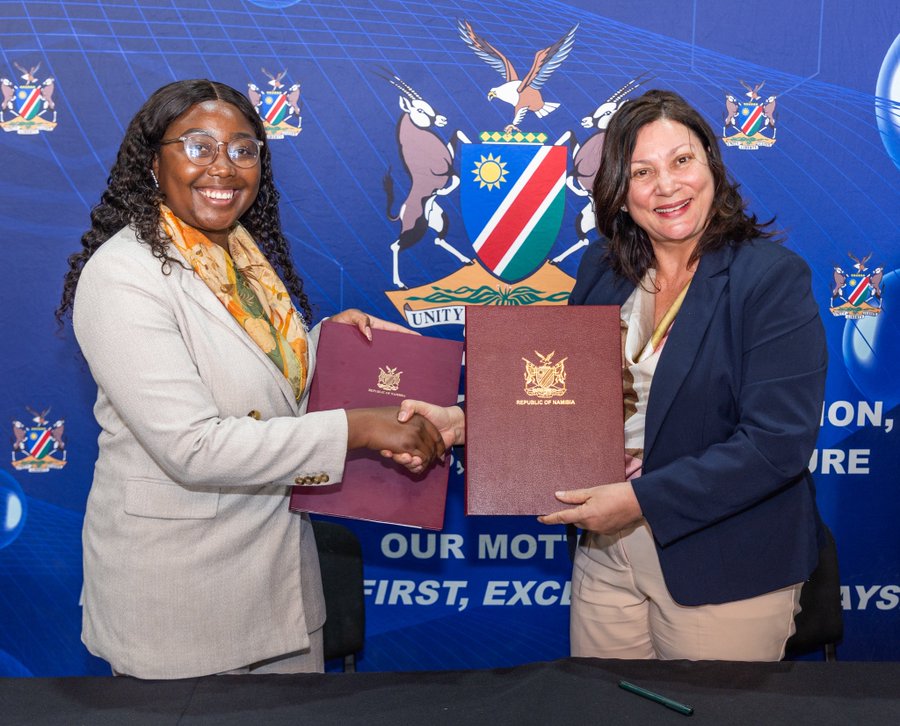
The Local Content Plan follows the signing of a Memorandum of Understanding between the Ministry of Education, Innovation, Youth, Sports, Arts and Culture and the Ministry of Information and Communication Technology on 17 August 2026 at the National Theatre of Namibia.
Information and Communication Technology Minister Emma Theofelus said the partnership is aimed at developing the creative industries into a stronger contributor to Namibia’s economy.
“The creative economy is increasingly recognised globally as an important source of jobs, entrepreneurship and export opportunities. For Namibia, this sector offers an opportunity to diversify our economy by transforming talent, cultural heritage and intellectual property into sustainable economic value,” Theofelus said.
The partnership is aligned with NDP6, which targets increasing employment in the creative industries to 2% by 2030 and raising the sector’s contribution to GDP to 2.8%.
The agreement covers capacity building, research and marketing, intellectual property rights protection, accelerator and mentorship programmes, creative entrepreneurship and infrastructure support.
Theofelus said the economic impact of film production extends into several other industries.
“Film connects multiple industries from acting, writing, directing and music to fashion, tourism, hospitality, transport, technology and marketing. A stronger Namibian film industry therefore creates opportunities far beyond the production of a movie itself,” she said.
The production of short films across all 14 regions is intended to spread opportunities beyond Windhoek and provide a platform for Namibia’s different cultures, languages, histories and experiences.
Funding will be released in three tranches linked to agreed milestones and deliverables, with government measuring outcomes including completed productions, jobs created, skills developed, equipment made available and enterprises supported.
The programme will be implemented by the Namibia Film Commission and the Directorate of Arts, supported by a Technical Committee responsible for guiding and monitoring implementation.
The Namibian Broadcasting Corporation is also expected to support the programme by providing platforms for locally produced content to reach audiences in Namibia and beyond.
“Our message today is therefore clear, Namibia must no longer view creativity simply as entertainment but a creative economic resource. Thus, our stories are intellectual property with the potential to create jobs, generate income and promote Namibia to the world,” Theofelus said.