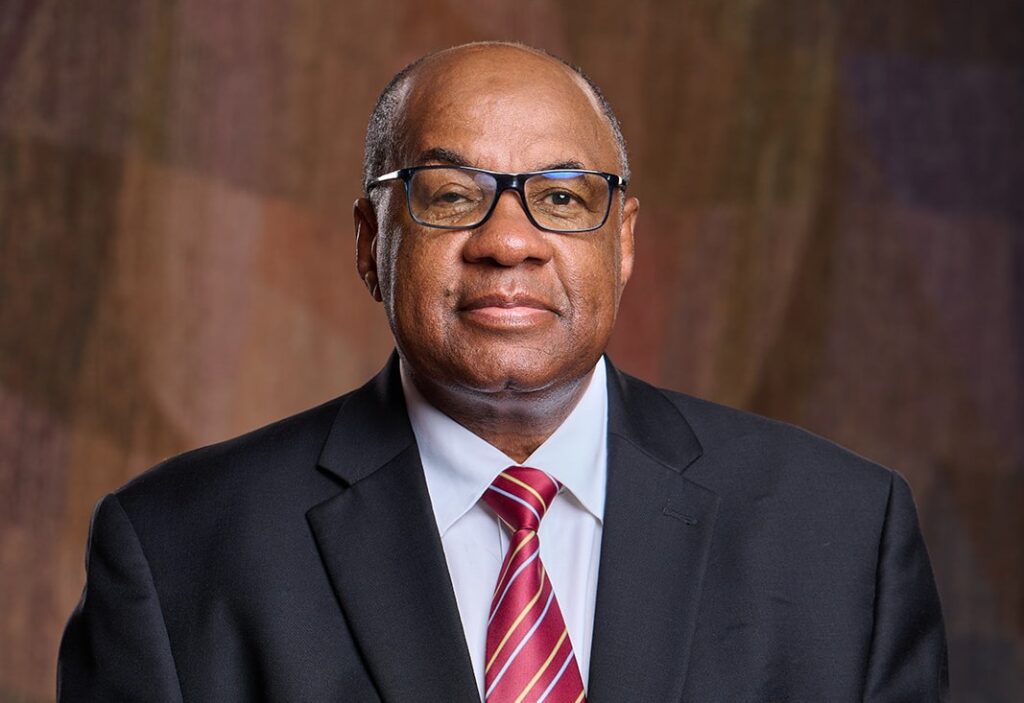
Outdated provisions in Namibia’s Competition Act, an unadjusted N$10 million merger threshold and weak coordination across government are constraining business activity and investment, former Bank of Namibia Governor Johannes !Gawaxab has warned.
!Gawaxab said the current regulatory framework is imposing unnecessary compliance costs, delaying transactions and limiting Namibia’s ability to attract investment and support economic growth.
“Businesses face additional compliance costs and delays in closing transactions that pose no competition risk. A more targeted definition would ensure regulatory oversight focuses on transactions with genuine competition implications,” he said.
He flagged the broad definition of “undertaking” in the Competition Act 2 of 2003 as a key concern, arguing that it captures transactions that do not materially affect competition.
“The scope of regulation needs to be narrowed to reduce unnecessary burdens on firms while preserving effective competition enforcement,” !Gawaxab said.
He also criticised the N$10 million merger notification threshold, saying it is outdated and no longer reflects current economic conditions.
“The threshold has not been adjusted for inflation or economic expansion. In real terms, it is significantly lower than when it was introduced, resulting in more transactions being subjected to regulatory scrutiny,” he said.
!Gawaxab noted that comparable jurisdictions have significantly higher thresholds, raising questions about the efficient allocation of regulatory resources in Namibia.
He further pointed to delays in resolving competition matters, warning that lengthy processes are creating uncertainty for investors.
“Competition cases and merger challenges can take between three to five years to conclude, creating significant uncertainty for businesses and potentially discouraging investment,” he said.
Beyond regulation, !Gawaxab highlighted weak policy coordination across government as a structural constraint, particularly in infrastructure development.
“Infrastructure planning is often fragmented across ministries. There is a need for a more integrated national framework to align priorities, funding strategies and implementation,” he said.
He proposed the establishment of a central coordinating mechanism to streamline infrastructure planning, structure public–private partnerships and engage strategic international partners.
“In a constrained fiscal environment, reliance on the national budget alone is unlikely to meet infrastructure financing needs. We must unlock private sector participation in bankable projects,” !Gawaxab said.
He added that Namibia’s mineral endowment presents an opportunity to position the country within global supply chains linked to electrification, decarbonisation and digitalisation.
“Namibia is well positioned, but this will require a more technical and coordinated policy approach to maximise long-term value,” he said.
!Gawaxab also raised concerns about the disconnect between economic growth and living standards, noting that rising costs of basic services continue to weigh on households.Economic growth figures do not always translate into improved living conditions, highlighting persistent inequality and the need to reassess how growth is measured and distributed,” he said.
Despite these challenges, he said the medium-term outlook remains positive, with growth projected to recover.
“Growth is forecast to rebound to 3.8% in 2026 and 4.3% in 2027, supported by agriculture, electricity and stronger mining output, particularly uranium,” !Gawaxab said.
He stressed that addressing regulatory inefficiencies, improving institutional capacity and strengthening policy coordination will be critical to positioning Namibia as a competitive economy in the region.
“The current environment presents an opportunity for Namibia to reposition itself as a responsive and competitive economy within Southern Africa,” he said.