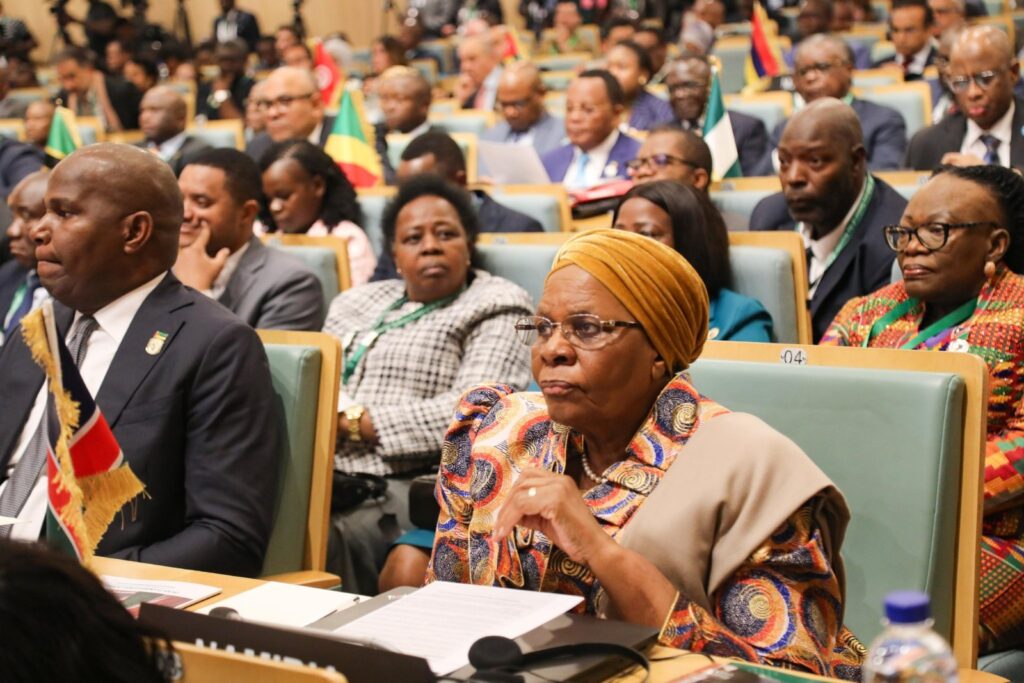
Namibia has created approximately 722 jobs for young entrepreneurs within five months through the National Youth Development Fund, President Netumbo Nandi-Ndaitwah said during the 35th Ordinary Session of the African Peer Review Forum.
Addressing the forum of heads of state and government, the President said the fund, launched in 2025, has disbursed N$62.3 million of its N$500 million allocation to support 140 youth-led projects.
“The National Youth Development Fund provides loans and grants without collateral, removing longstanding barriers for young entrepreneurs. Beneficiaries also receive mentorship to increase the chances of success,” Nandi-Ndaitwah said.
Reporting on progress under the African Peer Review Mechanism’s targeted review on youth unemployment in Namibia, covering the period from 1 December 2021 to 31 December 2025, the President outlined additional measures undertaken by government to address youth unemployment.
She said the Development Bank of Namibia has complemented the initiative by providing mentorship and training, with more than 400 young people trained under the 121 Rural Youth Enterprises Project, while over 1,500 participated in the Namibia Youth Credit Scheme during the 2023/24 and 2024/25 financial years.
Beyond entrepreneurship support, Namibia has expanded apprenticeship, internship and graduate trainee programmes across government offices, ministries, regional councils and local authorities. A minimum of 15 apprentices, 25 interns and 25 graduate interns were employed per institution, with stipends provided throughout their tenure.
“The Internship Programme has been extended to the private sector under the Youth Tax Allowance, allowing school-leavers, TVET graduates and university graduates to gain on-the-job experience while participating employers enjoy tax incentives,” Nandi-Ndaitwah said.
The President also noted that Namibia has strengthened Technical and Vocational Education and Training (TVET) as an alternative career pathway, with vocational training centres established in all 14 regions. Students pursuing trades at NQF Levels 1–6 receive full tuition and registration fee subsidies, while undergraduate students at public and private universities receive full funding for their first primary degree.
“To ease access to tertiary education, all undergraduate students pursuing their first primary qualification at public and private institutions receive 100% tuition and registration fee subsidy. TVET trainees also benefit from full subsidies,” she said.
Government has also prioritised the cultural and creative industries under the Sixth National Development Plan (NDP6), with initiatives such as TechNovation aimed at fostering innovation and entrepreneurship among micro, small and medium enterprises. By 2023, the arts, entertainment and recreation sector contributed 0.6% of total national employment.
“The Cultural and Creative Industries are a priority in NDP6, and initiatives like TechNovation are designed to accelerate youth development and foster innovation within MSMEs,” Nandi-NNdaitwah said.
She emphasised the importance of monitoring and evaluation to ensure full implementation of the National Programme of Action, aligning youth empowerment efforts with the Targeted Review Report on Youth Unemployment.
“Empowering the youth remains the greatest challenge facing our continent. A continent where young people are uncertain about their future is a continent at risk of failure. Let us give hope for a bright future to the youth of our continent. The youth is our future,” Nandi-Ndaitwah said.