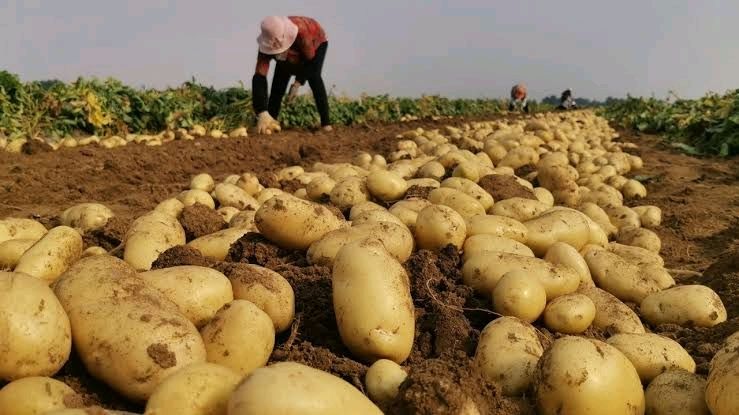
Namibia’s potato industry continues to fall well short of domestic demand, with annual consumption exceeding 40,000 tonnes while local production remains limited.
According to the Namibian Agronomic Board (NAB), formal market production stands at approximately 8,534 tonnes, leaving the country heavily reliant on imports to meet consumer demand.
The board said informal markets account for an estimated 41% of locally produced potatoes, highlighting the significant role of unregulated trade within the national supply chain.
During the 2024/25 financial year, potato imports reached 22,751 tonnes, underscoring Namibia’s continued dependence on foreign suppliers.
“Namibia produces only a fraction of the potatoes it consumes, creating a strong dependency on imported supplies to meet local demand,” the NAB said.
The board noted that the sector faces persistent structural constraints, including the absence of local seed potato production. Farmers are required to import all seed potatoes, a factor that increases input costs and often delays planting schedules.
Limited post-harvest washing and packaging capacity further restricts access to formal retail markets, while domestic processing of value-added potato products such as frozen chips and crisps remains non-existent, the NAB said.
“This keeps the country dependent on imports to supply both retail and fast-food sectors,” the board added.
Namibia’s potato imports are sourced mainly from South Africa, where average yields reach about 37 tonnes per hectare. In addition to fresh potatoes, Namibia imports around 3,754 tonnes of frozen potato products annually, as well as 2,173 tonnes of seed potatoes valued at more than N$20 million.
To protect domestic producers, the NAB enforces the Market Share Promotion scheme, which requires traders to source at least 47% of fresh produce locally. Borders are temporarily closed to imports when local supply is considered sufficient.
“Through the Market Share Promotion scheme and import management measures, we aim to safeguard local producers and support a more resilient domestic potato industry,” the board said.
The NAB identified opportunities to reduce import dependence, including the establishment of local seed multiplication systems, improved washing and packaging infrastructure, and the development of processing facilities. It also stressed the importance of training smallholder farmers in good agricultural practices to improve yields and quality.
“Investing in seed production, infrastructure, agro-processing and farmer capacity building can reduce import dependency and transform Namibia’s potato sector,” the board said.