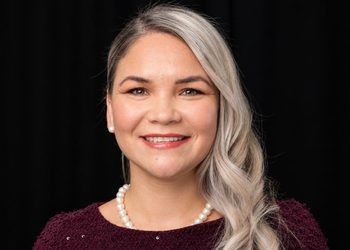
Ingah Ekandjo
I recently spoke at the opening of one of our top performing branches, prepared to talk about growth and community impact. But instead, I choked up. The room faded; my past came alive.
I grew up in a modest Namibian family of seven children. Not all of us could get student loans or bursaries, but my mother a government nurse with little savings had taken out an education policy (an insurance plan for schooling).
Listening to my introduction, memories of my childhood flashed before my eyes. In that moment I fully understood how that simple policy brought me here.
It paid for my education when no one else could afford it, opening doors I never imagined possible. That modest deduction invisible on her payslip became my bridge out of poverty. It carried me through school, put me through tertiary education, and placed me at that podium.
In that moment, I realised something painful: If Namibia ends payroll deductions, another child like me may never get the same chance.
Namibia’s policy shift: The payroll deduction directive
In August 2025, Namibia’s Ministry of Finance issued a directive: new voluntary payroll deductions (for insurance, loans etc.) can no longer be added under the existing Payroll Deduction Management System (PDMS). Existing deductions will be serviced until fully repaid, but the mechanism itself is being phased out.
The government cites procurement constraints and regulatory concerns (like microlenders relying on pay deductions instead of doing proper affordability assessments). Lenders now must assume more risk. Many fear credit terms will tighten, interest rates rise, and small insurance policies may become unviable under standard debit orders.
The quiet power of insurance cover
Covers like the education cover is one of those quiet products that seldom make headlines. It combines savings and insurance: parents contribute monthly, and if tragedy strikes death, disability, retrenchment the child’s education continues uninterrupted.
For families who live pay check to pay check, it is a lifeline. My mother did not have shares, property, or a stock portfolio. She had that deduction. Month after month, without fail, it secured my future.
Namibia at a policy crossroad
In the late 1990s, South African public servants were drowning under uncontrolled “stop orders” payroll deductions for loans, funeral cover, and insurance. Many ended up over indebted, with salaries sliced into dozens of small deductions.
In 2000, the government intervened. But it did not shut the system down. Instead, it regulated it through Treasury Regulation 23.
- Only vetted, credible institutions could access payroll codes, cutting out unscrupulous middlemen.
- Voluntary deductions were capped at 40% of an employee’s basic salary: insurance limited to 15%, other loans and deductions to 25%.
- Garnishee orders (court ordered debt repayments) required judicial oversight, protecting workers from predatory creditors.
- A centralised system (PERSAL) ensured deductions were properly managed, transparent, and audited.
This reform cleaned up abuse but preserved access. Workers could still pay for education policies, medical schemes, and insurance without the risk of losing everything. Botswana took a similar route, strengthening regulation rather than eliminating deductions.
The hidden costs: What happens when we switch to debit orders?
One of the most consequential shifts, if payroll deductions are discontinued, is that many payments will move to debit orders. On paper, they seem similar. But in practice, debit orders come with added costs, risks, and frictions especially for low income earners.
Failed debit orders cost more
Banks charge penalties when a debit order bounces when funds are insufficient or accounts are closed. For example, a local bank 2025 fee schedule lists “failed debit order” fees of 1.50% of the value, with a minimum of N$46 and a maximum of N$200. The entry level funeral insurance for a cover of N$10 000, has a premium of N$40 on average.
In other words, if someone is short by just a little, they face extra costs. And repeated failed orders can accumulate high penalties. This means that even when someone manages to pay, they lose a portion of the payment to bank fees not to insurance.
Increased cost burden for low-income clients
When you shift from invisible payroll deductions which are handled centrally at low marginal cost to individually enforced debit orders, you shift the operational burden and cost onto each family.
The poorest clients often have the least buffer. A single failed debit order might trigger default, penalty, and eventual cancellation of the policy. In effect, what was once a simple, low-friction system (payroll deduction) becomes a costly, risk-laden system (debit orders). For many, the friction will be the breaking point.
The social stakes: Who gets hurt?
Ending payroll deductions will not hit the wealthy. It will hit those at the bottom of the pyramid the clerk paying for funeral cover, the nurse saving for her child’s schooling, the teacher securing retirement insurance.
Many of these families cannot afford to manage policies manually. Missed payments will mean lapsed cover. And when tragedy strikes, it will be children who pay the price. This is not just about financial products. It is about breaking or reinforcing the cycle of poverty. It is about whether we build a Namibia where real financial inclusion is a privilege of the few, or a promise to all.
Household debt increasing
Namibians are borrowing too much, and the numbers prove it. By 2024, household debt stood at almost N$68 billion, according to the Bank of Namibia. That is not larger than the economy itself, but it’s large enough to worry anyone who cares about stability. On average, families are committing 40 to 45 % of their disposable income to servicing debt. Nearly half of GDP is tied up in private sector credit.
These are not just abstract statistics. They reflect real households living paycheque to paycheque, one interest rate hike or payroll disruption away from default. If we ignore the warning signs, today’s household debt will become tomorrow’s foreclosure, insolvency, and economic contagion.
The solution cannot be left to households alone. Policymakers, employers, and banks must act together. Regulators should tighten lending rules and cap reckless unsecured credit. Employers must strengthen financial wellness programmes and safeguard repayment systems. Banks, for their part, need to shift from short-term profit to long-term client stability. And government must invest in structural reforms affordable housing finance, debt counselling, and financial literacy to rebalance the economy.
Namibia cannot afford a debt-fuelled economy that erodes family security and national resilience.
A call to preserve and improve
Namibia can learn from South Africa. Instead of cutting off payroll deductions, we can regulate them better:
- Vetting and approval: Only licensed, credible insurers and lenders should have access.
- Caps and safeguards: Set strict limits to protect take home pay.
- Transparency and education: Ensure employees know what deductions they are signing up for and how they affect their salaries.
- Digital innovation: Use mobile platforms to complement payroll, making it easier to monitor and manage.
But do not remove the mechanism altogether. Because for thousands of families, that mechanism is the only path to financial discipline and upward mobility.
A call to preserve the promise
Financial inclusion is not just about how many people have bank accounts. True inclusion is about whether ordinary workers can use financial tools that improve their lives and use those financial tools meaningfully. Can a nurse, a teacher, a cleaner, someone earning an average salary set aside a small amount for their child’s schooling without friction? Save towards their retirement? Afford the security of life or funeral cover without being weighed down by monthly debit orders?
Access without usability is an empty promise. For the nurse in Oshakati, the teacher in Katima Mulilo, or the cleaner in Windhoek, inclusion means being able to set aside N$200 for their child’s future without complicated processes or the temptation to spend it elsewhere. Payroll deduction has made that possible.
As Nobel laureate Joseph Stiglitz reminds us: “Governments can enhance growth by increasing inclusiveness. A country’s most valuable resource is its people. So, it is essential to ensure that everyone can live up to their potential, which requires educational opportunities for all.”
If we remove payroll deductions, we risk reducing inclusion to a statistic on paper, while in practice the not so wealthy lose opportunities.
My own story is proof of what is possible when systems work for the vulnerable. My mother’s deduction invisible on a payslip is the reason I am here. It is the reason I was not trapped by circumstance.
Namibia must ask: do we want to build a society where real financial inclusion, generational wealth is a privilege of the few, or one where it is a promise to all?
South Africa chose reform, not removal. Namibia should do the same. Because every small deduction is not just money taken from a salary it is hope invested in a child’s future.
When financial exclusion persists, inequality deepens. Stiglitz warns against systems that become “justice for those who can afford it, rather than justice for all”. In other words, if only the wealthy can navigate or access financial services, we create a society of closed doors, not open ones.
* Ingah Ekandjo is the Executive Officer of Momentum Metropolitan Namibia Retail Distribution.