President Netumbo Nandi-Ndaitwah has called for the removal of barriers to investment and business growth as Namibia grapples with slowing economic growth, rising inflation and limited fiscal space.
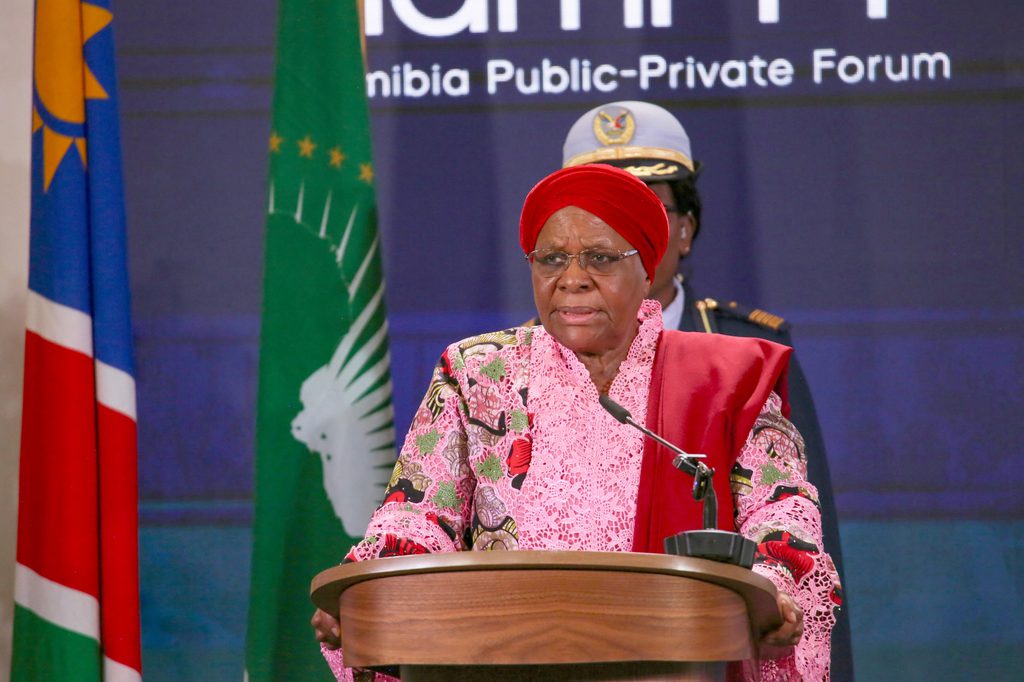
Speaking at the second Namibia Public-Private Forum (NamPPF) in Windhoek, Nandi-Ndaitwah said government and the private sector must move beyond policy discussions and implement measures that unlock investment, accelerate industrialisation and create employment.
“The NamPPF gives us a common table where we can identify constraints, agree on solutions, and hold ourselves accountable for implementation,” she said.
Her remarks come as Namibia’s economic growth slowed to 1.7% in 2025, with the Bank of Namibia projecting growth of 2.1% in 2026.
The economic outlook remains under pressure from weaker performance in agriculture, diamond mining, manufacturing and services, compounded by the effects of the Middle East conflict and the outbreak of foot-and-mouth disease.
Inflation also increased to 5.6% in October 2026 from 3.6% during the corresponding period last year, while government faces lower revenue expectations and rising debt-servicing obligations.
Nandi-Ndaitwah said addressing structural constraints to economic growth required greater accountability from both government and the private sector.
Following the inaugural public-private forum in October 2025, Cabinet issued 34 directives across nine priority interventions aimed at addressing barriers to investment, economic activity and service delivery.
Government also established three Presidential Task Forces focusing on economic recovery, health, and housing and land delivery, supported by 10 working groups.
The National Planning Commission and the Namibia Investment Promotion and Development Board are developing an accountability framework and dashboard to monitor implementation, identify bottlenecks and track outstanding commitments.
Among the measures implemented is the operationalisation of the One-Stop-Shop Business Facilitation Centre at the Business and Intellectual Property Authority (BIPA), although challenges relating to interconnectivity and the digitalisation of processes remain.
Government has also introduced a five-year Investor Visa, while the Investment Bill and Tax Reform Bill are before the National Assembly.
Nandi-Ndaitwah said attracting investment must be accompanied by increased local value addition and greater participation by Namibian businesses across agriculture, fisheries, mining, energy, oil and gas, manufacturing, tourism and the creative industries.
She called for greater investment in domestic processing, technology transfer, skills development and local supplier development to expand employment and business opportunities.
The President also emphasised the need to align education and training with industry requirements, particularly in technical, vocational, digital and entrepreneurial skills.
She said small and medium-sized enterprises (SMEs) and startups must be integrated into industry supply chains through improved access to finance, markets and business opportunities.
Nandi-Ndaitwah said the public-private forum should become a continuous platform for addressing economic constraints, with its success measured by barriers removed, investments mobilised and jobs created.