Tuesday, November 17, 2026
Subscribe
The Brief | Namibia's Leading Business & Financial News
  • Home
  • Companies
    • Finance
    • Agriculture
    • Technology
    • Property
    • Trade
    • Tourism
  • Business & Economy
  • E-PAPERreader
  • Mining & Energy
  • Opinions
    • Analysis
    • Columnists
  • Africa
No Result
View All Result
The Brief | Namibia's Leading Business & Financial News
Subscribe
No Result
View All Result
Home Opinions

Why good strategies fail: Namibia’s execution problem

by reporter
October 8, 2026
in Opinions
11
A A
Smiling Black woman with braided hair, large black glasses, and a blazer, resting her chin on her hand.

By Zaapi Zee Mungendje

Namibia is not short of strategic ambition.

Across businesses, public institutions and state-owned enterprises, considerable effort goes into developing strategic plans.

Objectives are defined, priorities agreed, KPIs established and a direction for the future articulated.

Yet the real test begins after the strategy is approved: Can the organisation actually change the way it works in order to deliver it?

This is where many otherwise sound strategies begin to lose momentum.

We often think of execution as something that comes after strategy; first we decide where we are going, then the organisation implements the plan.

In practice, however, the distinction is far less clear because strategy only becomes meaningful when it begins to influence how an organisation behaves.

Execution is strategy made visible.

Richard Rumelt, in Good Strategy/Bad Strategy, reminds us that strategy requires more than ambition. It demands a clear understanding of the challenge, deliberate choices about how to respond, and coherent action.

This last element matters because a strategic priority that does not eventually change decisions, resources or behaviour remains little more than an intention.

Execution therefore begins to break down when everything becomes a priority: too many initiatives, unclear choices and resources stretched across competing demands.

This challenge becomes even more pronounced in public institutions and state-owned enterprises, where strategy must operate within existing mandates, governance requirements, budget cycles, reporting obligations and multiple stakeholder expectations.

As a result, the issue is not necessarily the absence of good strategy or capable people.

Sometimes, people are simply being asked to deliver a new strategy through an operating model designed for the old one.

A new strategy may be approved, yet the organisation it lands in does not suddenly become a different organisation.

Existing responsibilities remain, projects continue, budgets may already be committed and established processes stay in place.

When new strategic priorities are then added on top of these existing demands, the organisation begins to accumulate rather than choose.

A new programme leads to another project, another committee, another KPI and another reporting requirement. Over time, the organisation is no longer executing a clear set of strategic choices; it is carrying a collection of ambitions.

The distinction matters because strategy requires choices, and management attention, time and resources are finite. Consequently, effective execution is not only about deciding what deserves attention; it also requires clarity about what will no longer receive it.

Vijay Govindarajan’s The Three-Box Solution offers a useful lens for understanding this tension. Organisations must manage the present, selectively let go of the past and create the future simultaneously. The difficulty, in many cases, lies in letting go.

We are generally comfortable adding tomorrow, while being far less comfortable removing yesterday. Transformation, however, cannot be addition without subtraction.

If digitalisation is strategic, which manual process will disappear? If customer experience is a priority, where will resources move? If innovation matters, what room has been created for experimentation? If five new priorities are introduced, what are we prepared to stop doing?

These questions matter because execution is ultimately reflected in budgets, responsibilities, management attention, performance measures and everyday decisions.

Strategy should therefore influence not only what an organisation intends to achieve, but also where it concentrates its resources and what it deliberately chooses not to pursue.

Perhaps every strategy session should end with one simple question:

What will actually change because we have chosen this strategy?

Strategy execution is not simply about asking people to do more. It is about enabling the organisation to do differently. If nothing changes beyond the strategy document, the results will eventually tell us so.

*Zaapi Zee Mungendje is a strategy and business professional with executive education in Disruptive Strategy, Business Strategy and Strategy Execution through Harvard Business School. She writes about strategy, innovation and organisational execution.


author avatar
reporter
See Full Bio
Previous Post

Robert McGregor takes over as Cirrus Securities Managing Director

Next Post

When financial support matters most

Must Read

Close-up portrait of a man in a black suit and white shirt with a black tie, set against a dark background. The image shows only the upper part of his face and shoulders.
Opinions

The illusion of coexistence: Is Namibia’s human-wildlife conflict policy serving rural farmers?

November 17, 2026
Woman with long curly hair in a navy blazer stands in front of a wooden bookshelf lined with books and photos.
Opinions

Who gets backed? How gut feeling decisions are holding Namibian startups back

November 17, 2026
Professional headshot of a man in a light beige suit, blue shirt, and blue patterned tie, looking at the camera.
Opinions

Perspectives of a young professional

November 16, 2026
Impact Property Fund listing signals new depth for Namibia’s capital market
Opinions

Your bank pays dividends. Are you receiving them?

November 16, 2026
Front three-quarter view of a dark green Tiggo 8 Pro Max SUV driving on a highway.
Analysis

140 Chery vehicles in Namibia face recall over major safety concerns

November 13, 2026
Leader brand and institutional brand incongruence
Opinions

500 000 Jobs: How a country operates against that deliverable !

November 13, 2026
Load More

Related News

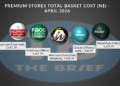
Banner displaying premium stores' total basket cost (N$) for April 2026, with store logos and their costs: Superspar (Grove Mall) 1,645.79; Model (Auas Valley) 1,638.79; Food Lover's Market (Hilltop) 1,601.79; Checkers (Maerua Mall) 1,530.79; Woermann Fresh (Klein Windhoek) 1,508.79.

Woermann Fresh (Klein Windhoek) claims the most affordable basket in April 2026 – Premium Stores

May 4, 2026
Communicating cybersecurity to the board

Communicating cybersecurity to the board

January 30, 2023
Private sector credit expansion weakens amid economic uncertainty

Private sector credit expansion weakens amid economic uncertainty

September 2, 2024

Browse by Category

  • Africa
  • Agriculture
  • Analysis
  • Business & Economy
  • Columnists
  • Companies
  • e-edition
  • Finance
  • Finance
  • Fisheries
  • Green Hydrogen
  • Health
  • Investing
  • Latest
  • Market
  • Mining & Energy
  • Namibia
  • namibia
  • News
  • Opinions
  • Property
  • Retail
  • Technology
  • Tourism
  • Trade
The Brief | Namibia's Leading Business & Financial News

The Brief is Namibia's leading daily business, finance and economic news publication.

CATEGORIES

  • Business & Economy
  • Companies
    • Agriculture
    • Finance
    • Fisheries
    • Health
    • Property
    • Retail
    • Technology
    • Tourism
    • Trade
  • e-edition
  • Finance
  • Green Hydrogen
  • Investing
  • Latest
  • Market
  • Mining & Energy
  • namibia
  • News
    • Africa
    • Namibia
  • Opinions
    • Analysis
    • Columnists

CONTACT US

Cell: +264814612969

Email: newsdesk@thebrief.com.na

© 2026 The Brief | All Rights Reserved. Namibian Business News, Current Affairs, Analysis and Commentary

Welcome Back!

Login to your account below

Forgotten Password?

Retrieve your password

Please enter your username or email address to reset your password.

Log In
No Result
View All Result
  • Home
  • Companies
  • Mining & Energy
  • Business & Economy
  • Opinions
    • Analysis
    • Columnists
  • Africa

© 2026 The Brief | All Rights Reserved. Namibian Business News, Current Affairs, Analysis and Commentary

This website uses cookies. By continuing to use this website you are giving consent to cookies being used. Visit our Privacy and Cookie Policy.