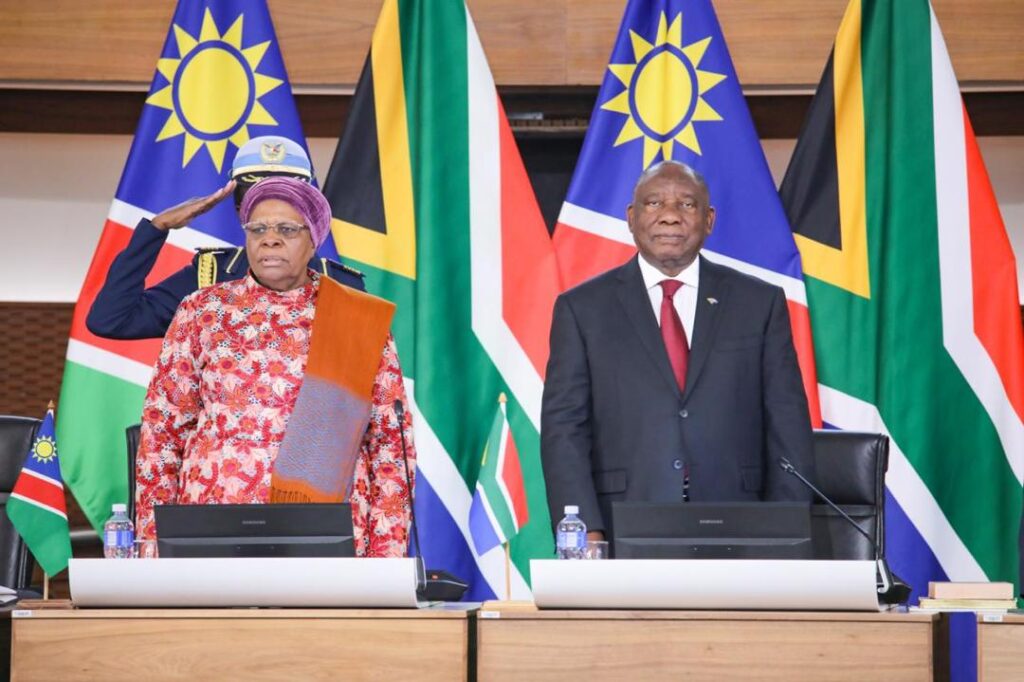
Namibia and South Africa have agreed to explore the introduction of a Digital Balance Scorecard to monitor the implementation of bilateral agreements, as the two countries seek to improve accountability and accelerate delivery of key projects agreed under the Fourth Session of the Namibia-South Africa Bi-National Commission (BNC) held last week.
President Netumbo Nandi-Ndaitwah said officials from both countries will engage the Southern African Development Community (SADC) Secretariat on adapting the digital monitoring system to track progress on decisions taken by the commission.
The initiative forms part of a broader effort to shift the BNC’s focus from signing agreements to ensuring they are implemented.
“The key word in my statement is implementation. It is no longer business as usual for those responsible for implementing the decisions of our Bi-National Commission. We must deliver, account for, and address the needs of our people,” Nandi-Ndaitwah said.
She said the outcomes of the Fourth Session of the BNC have the potential to help address shared socio-economic challenges, including youth unemployment, economic inequality, climate vulnerability and food insecurity, provided they are effectively implemented.
As part of the renewed implementation agenda, the two countries agreed to fast-track several strategic projects, including the completion of the Presidential Drought Relief Programme, the expansion of the Trans-Kalahari Corridor, and continued collaboration on regional energy initiatives.
Nandi-Ndaitwah also thanked South Africa for its R100 million Presidential Drought Relief Programme, confirming that the remaining R27 million will fund the second phase of borehole installations in Namibia.
“The remaining R27 million is earmarked for the second phase. By expanding access to clean, reliable water in an arid country like Namibia, this project strengthens livelihoods and reaffirms our responsibility to one another,” she said.
The President further acknowledged that the Orange River boundary dispute remains unresolved despite progress made by technical experts, expressing confidence that the two countries would continue working towards a mutually acceptable solution.
South African President Cyril Ramaphosa echoed the call for stronger implementation, saying the effectiveness of the commission would be measured by the delivery of agreed projects rather than the number of agreements concluded.
“The true measure of our success, however, will not be the number of agreements we sign, but the effectiveness with which we implement them. Implementation must now become our foremost priority,” Ramaphosa said.
He added that Namibia and South Africa should continue strengthening cooperation in trade, investment, infrastructure, industrialisation and regional value chains to unlock economic opportunities and deepen regional integration.