By Jason Hailonga
Few debates in investing have become as persistent, and at times as emotional, as the debate between passive and active investing.
On one side are the advocates of passive investing. Their argument is simple and powerful: markets are difficult to beat, costs matter, and investors are often better served by owning the market rather than trying to outsmart it.
On the other side are active managers, who argue that markets are not always rational, prices do not always reflect value, and skilled investors can add meaningful value through research, judgement, and disciplined portfolio construction. Both sides have a point.
The rise of passive investing has been one of the most important developments in modern financial markets.
Since index investing became popular in the 1970s, passive strategies have lowered costs, improved access, increased transparency, and allowed millions of investors to participate in the long-term growth of markets.
The proposition is attractive because it is simple: instead of trying to beat the market, investors can own the market. For many investors, this is not settling. It is sensible.
Capturing the broad return of an asset class at a low cost can be a very effective investment strategy, particularly over long time horizons. In fact, in a world where many active managers fail to outperform their benchmarks after fees, the appeal of passive investing is easy to understand.
The data supports this. Passive investing has moved from being a niche idea to becoming one of the dominant forces in global asset management.
According to S&P Dow Jones Indices, approximately US$13 trillion directly tracked the S&P 500 as at December 2024, representing more than one-fifth of the entire US equity market. In early 2024, assets invested in passive US equity funds surpassed active equity funds for the first time in history, marking a significant milestone in global asset management.
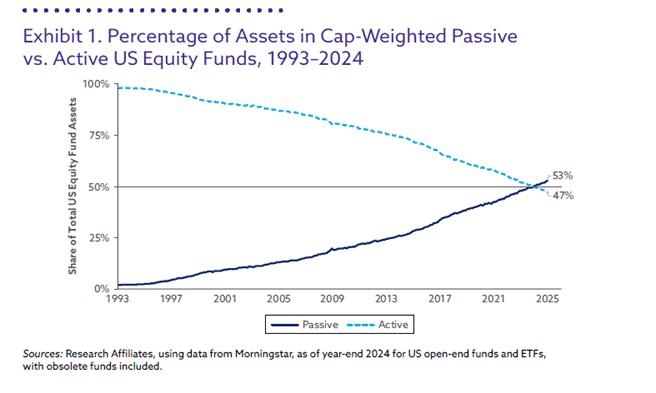
This marks an important shift in investor behaviour: investors are increasingly voting with their money for simplicity, lower fees, and broad market exposure.
The theoretical foundation for passive investing is also strong. The Efficient Market Hypothesis argues that market prices quickly reflect available information, making it difficult to consistently identify mispriced securities. If markets are highly efficient, active management becomes a difficult game: before costs, it is competitive; after costs, it becomes even harder. But this is where the debate becomes more interesting.
Markets may be efficient over time, but they are not always efficient all the time. Markets are not machines.
They are made up of people, and people are emotional. Fear, greed, overconfidence, herding behaviour, short-termism, and panic can all influence prices. Markets can become too optimistic in good times and too pessimistic in bad times. Prices can move away from fundamentals, sometimes dramatically.
That is where active management earns its place. Active investing is not about claiming that markets are always wrong.
It is about recognising that markets can be wrong often enough, and meaningfully enough, for disciplined investors to add value. The role of an active manager is to identify those moments where price and value have separated, and to allocate capital accordingly.
This is especially important in less efficient markets. In developed markets, where information is widely available, companies are heavily researched, and liquidity is deep, it can be difficult for active managers to gain a consistent edge.
In emerging and frontier markets, the picture can be different. These markets often have lower liquidity, less analyst coverage, greater regulatory complexity, uneven information flow, and wider valuation gaps between companies.
For investors in markets such as Namibia and the broader African region, this matters. A purely passive approach may give exposure, but it may not always provide the flexibility required to manage risk, navigate structural changes, or identify opportunities that are not properly reflected in index weights.
This is a crucial point: active management should not only be viewed as a pursuit of outperformance. It can also be a risk management tool.
An index does not ask whether a company is overvalued. It does not assess governance quality. It does not consider whether a business model is deteriorating. It does not reduce exposure because risks are rising. It simply follows its rules.
That is both the strength and the weakness of passive investing. Passive investing brings discipline, cost efficiency, and transparency. But it also removes judgement. In periods of market stress, geopolitical uncertainty, inflation shocks, interest-rate shifts, or major economic transitions, judgement becomes valuable.
Active managers can assess fundamentals. They can distinguish between temporary volatility and permanent impairment. They can reduce exposure to areas where risks are not being adequately rewarded.
They can identify companies or instruments that are being unfairly punished by the market. They can also build portfolios that are not simply a reflection of the largest index constituents.
Of course, active investing has its own risks. The pursuit of above-average returns necessarily creates the possibility of below-average outcomes.
Not every active manager will succeed. Even skilled managers can go through periods of underperformance, particularly when their investment style is out of favour. Investors therefore need to be honest about their own risk tolerance, time horizon, and expectations.
This is where the active versus passive debate often loses its usefulness. The real question is not whether passive is better than active, or whether active is better than passive. That framing is too simplistic. The better question is: what combination of strategies gives the investor the best chance of achieving their objective?
In many portfolios, passive strategies can be used to gain efficient, low-cost exposure to broad markets. Active strategies can then be used selectively where there is a stronger case for manager skill, market inefficiency, downside protection, income generation, or specialised opportunity. This is not a contradiction. It is good portfolio construction.
At Momentum Investments, this thinking is central to our Outcome-Based Investing approach. We believe investment decisions should start with the client’s objective, not with a product, benchmark, or investment fashion.
Investors are not investing simply to beat an index. They are investing to retire with dignity, preserve capital, generate income, fund liabilities, grow wealth, or meet long-term institutional obligations. The benchmark is important, but it is not the client’s life. The client’s outcome is the real objective.
That means portfolio construction must begin with three practical questions:
- What return does the investor need?
- How much risk can the investor tolerate?
- Over what time period must the outcome be achieved?
Once those questions are answered, the role of active and passive investing becomes clearer. Passive investing can help capture market returns efficiently. Active investing can help navigate uncertainty, manage risks, and seek opportunities where markets may be inefficient.
The future of investing is therefore unlikely to belong exclusively to passive or active strategies. It will belong to investors who understand when to use each tool, why they are using it, and how it supports the outcome they are trying to achieve. Passive investing has earned its place. Active investing still has a role to play.
The most successful investors will not be those who win the active-versus-passive argument. They will be those who build portfolios with discipline, humility, and a clear understanding of the outcome they are trying to deliver.
That is ultimately the essence of successful investing.
* Jason Hailonga is the Managing Director, Momentum Investments Namibia