By Lameck Mbangula Amugongo
The recently published Namibia Artificial Intelligence Readiness Assessment Report, compiled in partnership with UNESCO, has been hailed as a landmark document.
It claims to provide a comprehensive overview of Namibia’s AI landscape, assesses gaps, and outlines recommendations for ethical and responsible AI adoption in Namibia.
While the effort is commendable and the intentions noble, the report ultimately offers little that is new. Many of its recommendations echo those already presented in the 4th Industrial Revolution (4IR) Task Force report.
Calls for a national AI institute, improved digital skills, stronger infrastructure, and ethical governance frameworks have been on Namibia’s to-do list for the last 3/4 years.
Repackaging these points under the banner of “AI readiness” does not constitute a fresh idea; it’s a restatement of what we already know.
In the fast-paced AI field, reports are not what create breakthroughs — practical implementation is. OpenAI, for example, did not produce a readiness assessment before building ChatGPT.
Instead, it leveraged the expertise of highly skilled engineers and researchers, iteratively building and testing models until they reached global impact.
Namibia, if serious about harnessing AI, must understand that progress comes from building, experimenting, and deploying — not from repeated diagnostics that end up as shelf documents with no practical impact for society.
The report also highlights that institutions like NUST and UNAM are “working on AI” and offering related degrees.
While these initiatives sound impressive, we must be frank: this is just throwing buzzwords over substance. A review of research outputs in AI from Namibia’s universities shows that our contributions to the global AI knowledge pool are almost non- existent.
Having a “Bachelor’s in AI” programme means little if the lecturers themselves lack deep, practical AI expertise.
Namibia’s most urgent AI need is not more readiness assessments, but the cultivation of highly skilled people.
The millions spent on such reports could be reallocated to grassroots AI capacity building in all 121 constituencies. Imagine if, instead of funding another study, we invested in upgrading 14 rural schools per year with electricity and fully equipped computer labs.
In five years, 70 rural schools could be AI-ready, giving thousands of young Namibians the skills to participate in the future economy. That would be genuine readiness for the future.
The idea of a National AI Institute outlined in the report is indeed worth pursuing — but only if it is led by someone with real technical expertise and research credibility in AI.
The same goes for policy-making – yes, Namibia needs AI laws and regulations, but before legislating, we must define the ethical principles that will guide the kinds of AI systems we develop and deploy.
Regulation should evolve alongside real-world AI projects, not in isolation.
Moreover, in the AI readiness report there is a lot of conflation of AI policy with ICT policies such as data protection. We need to stop conflating AI policy with ICT policies. Such conflation does not help but lead to conflating expertise.
While ICT policies and data protection are important, they are distinct from AI. The United States, the world leader in AI, has no federal data protection law. Europe, despite its GDPR, is now reconsidering aspects of it to avoid stifling innovation. Namibia’s AI policy must be its own distinct framework.
In conclusion, AI is the most defining technology of our time. If Namibia wants to participate meaningfully, our focus must shift from repetitive reporting to practical implementation, inclusive capacity building, robust infrastructure investment, and state of the art research outputs.
Readiness is not about what’s written in a document — it’s about what’s being built in classrooms, labs, and communities. Until then, our readiness will remain theoretical, and our AI future will be built elsewhere.
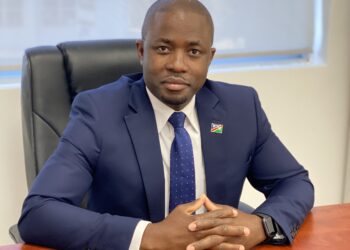
*Dr Lameck Mbangula Amugongo is an AI specialist and AI Ethics Advisor based in Europe. He holds a PhD in Cancer Sciences from the University of Manchester. The views expressed are his own.