The World Economic Forum has confirmed 2024 as a record year for elections with over 2 billion voters heading to the polls to determine their fate Namibia joins the ranks of the US EU India South Africa Mexico Russia and others who will be hosting their elections This year is therefore highly consequential for global politics
Nonetheless all parties who are vying for the highest office in the land of the brave have a responsibility to prove themselves worthy of leading our beautiful nation Its incumbent on all parties to leave nothing to chance as it pertains to clarifying their tangible intended development strategies for economic and social progress Vague sentiments are insufficient as the days of voting along camaraderie lines are increasingly fading
As it stands Namibia has been hailed as an African success story The US Department of State has cited an independent judicial system protection of property and physical as well as telecommunications structure as reasons for the countrys success Its booming energy industries contribute to its glory The elephant in the room however is Namibias World bank ranking as the second most unequal country in the world with a Gini coefficient of 591 second only to South Africa It would therefore be intellectually dishonest to fully agree that Namibia is indeed a success story
An incoming administration is lucky enough to have a functional democracy as its starting point but it also faces the responsibility of addressing access to energy as an existential national concern As per President Geingobs Harambee Prosperity Plan II focused on Infrastructure Development Namibia grapples with an internal energy supply that falls short of meeting even one third of the nations demand
In 2020 the local installed capacity stood at 624 MW The National Integrated Resource Plan NIRP further illuminates the energy landscape revealing that the current peak demand is at 673 MW with projections indicating an increase to 931 MW by the conclusion of HPPII in 2025 and a substantial rise to 1348 MW by 2030 Shockingly access to electricity is limited to less than half of the population
Electricity access can be a tool for the manifestation andor consolidation of political power extending far beyond its role as a mere commodity The control wielded by authorities over energy infrastructure its distribution and overall availability is inherently political influencing the socio economic landscape and the perception of governance efficacy
A governments capacity to ensure uninterrupted power supply becomes a tangible manifestation of its administrative competence Consequently challenges in electricity provision can quickly transform into points of contention laying bare governmental shortcomings and potentially escalating into catalysts for social unrest Neighbouring South Africas oft cited energy challenges must signal that we are not immune to a similar fate
Beyond the political sphere access to electricity plays a pivotal role in shaping the spatial organization of society exerting a profound impact on urbanization patterns and social stratification In electrified urban centers economic activities tend to thrive creating hubs of prosperity The spatial distribution of electricity becomes a crucial determinant of economic disparities and social inequalities Areas with reliable and consistent power supply often witness concentrated economic development fostering the emergence of affluent neighbourhoods and commercial districts
Conversely regions with inadequate or irregular electricity access are relegated to the peripheries of economic activity perpetuating cycles of poverty and reinforcing existing social hierarchies This spatial organization is not merely a consequence but also a perpetuator of existing power structures Dare I say it is reminiscent of socio economic organization under the colonial project In essence electricity beyond its technical function becomes a tool through which political power is projected and societal structures are shaped
The control over energy infrastructure and its distribution reflects and influences governance effectiveness while the spatial consequences of electricity access contribute to the perpetuation of economic disparities and social inequalities Recognizing the political dimensions of electricity access as a dynamic force is crucial in ensuring that Namibians are not subjected to painful reminders that trickle down economics does not work
Margaret Thatcher former Prime Minister of the UK has stated that popular capitalism is the economic expression of liberty It can therefore be understood that capitalism is not just about transactions but a continuous expression of individual influence in economic systems Energy access therefore democratizes market participation serving as a channel where the liberty choice and dignity of Namibian citizens find direct expression
As the country approaches the 2024 general election the discourse on electricity access must be considered a litmus test for governance effectiveness and economic equity
The upcoming election must compel us as voters to consider candidates visions for Namibias energy future as a conduit for power that influences core principles of choice and dignity
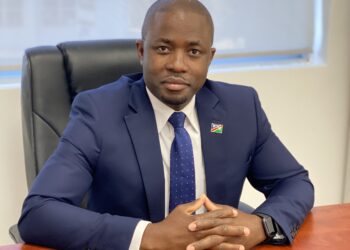
Bertha Tobias is a Rhodes Scholar Elect for post graduate studies at Oxford University She holds a Bachelors Degree Honours in International Relations with a concentration on Energy Connect on berthaberthatobiascom