Monday, October 12, 2026
Subscribe
The Brief | Namibia's Leading Business & Financial News
  • Home
  • Companies
    • Finance
    • Agriculture
    • Technology
    • Property
    • Trade
    • Tourism
  • Business & Economy
  • E-PAPERreader
  • Mining & Energy
  • Opinions
    • Analysis
    • Columnists
  • Africa
No Result
View All Result
The Brief | Namibia's Leading Business & Financial News
  • Home
  • Companies
    • Finance
    • Agriculture
    • Technology
    • Property
    • Trade
    • Tourism
  • Business & Economy
  • E-PAPERreader
  • Mining & Energy
  • Opinions
    • Analysis
    • Columnists
  • Africa
No Result
View All Result
The Brief | Namibia's Leading Business & Financial News
Subscribe
No Result
View All Result
Home Latest

Glass shortage hits booze sellers

by editor
January 12, 2022
in Latest
6
A A

South Africa’s large alcohol producers are struggling to satisfy demand, which is hitting tavern owners hard.

South African Breweries (SAB) confirmed that due to “supply chain constraints” it can’t deliver all customer orders, while Distell, which produces Savanna, Hunter’s and Klipdrift, says it is experiencing “severe” glass shortages, as well as a shortage of aluminium, used in the production of cans, and corks.

In KwaZulu-Natal, Nhlanhla Mbhele had no choice but to shut down his 15-year-old tavern, Oskido247, in Empolweni after struggling to find product to sell.

Like many other people who sell liquor, Mbhele sourced most of his supply from producers SAB and Distell. His biggest moneymakers were beer brands Carling Black Label, Castle and Hansa, all sold by SAB, and popular cider Savanna, from Distell.

But he has been struggling to get these products from the big providers.

“I closed down my business, there’s nothing I can do, because customers wanted alcohol and I couldn’t provide it to them. It was a mockery [of the customers] because you [for instance] want [Carling] Black Label and I didn’t have it, you wanted Savanna and you couldn’t find it,” he said.

The lack of communication from both SAB and Distell didn’t help, said Mbhele. In his experience, tavern owners are sometimes starved of supplies and are told that there is no Carling Black Label or Castle available. But this is not followed up by an explanation, leaving them in the dark.

He says that supplies also come late, like on a Sunday instead of a Friday, ahead of crucial weekend trading – even when tavern owners pay ahead of time. Because there aren’t other large alcohol providers, there’s nowhere else for them to turn. 

Dudu Gumbi, who owns End of the Road, a tavern in Ntuzuma, also in KwaZulu-Natal, says in addition to unreliable supply, when they do get liquor, it is rationed. 

“It’s a big struggle,” said Gumbi.

“What can we do with 10 cases of Castle? What can we do with five [cases of] Hansa Pilsner?” she said.

The tavern owner explained that the rationing of supplies means that they must spend more money on transport to make many trips to the warehouse where they buy the liquor.


Glass supplies have been a problem in South African since last year, when large glass manufacturers had to shut their furnaces during the peak of hard lockdown and amid alcohol sales bans. For example, Consol lost more than 100 000 tons, or 12% of its total output. The production of cans has also been impacted by surging prices of aluminium, which hit a 13-year record last year.

But SAB said its sales representatives keep in contact with customers regarding any stock shortages and to ensure fair allocation of beverages to all its customers.

Distell says global shipping disruptions have compounded shortages in glass, aluminium and corks, which is hitting its production.

A sharp recovery in demand for products across the world has put strain on the world’s supply chains, with a shortage of shipping containers and warehouse capacity in many countries adding to delays. Meanwhile, there is congestion at ports, and in some Western countries, truck drivers are in short supply.

In China, a major centre of international manufacturing, ports and factories were closed after surges in new Covid-19 cases towards the end of last year.

“Unfortunately, this has impacted on our ability to supply certain products to our customers and consumers. Our situation is more acute due to the rampant demand for key brands such as our single malt scotch whiskies, Amarula and for some of our most popular products –  which include Savanna –  which have experienced phenomenal growth,” said Distell’s spokesperson Dennis Matsane.

Lucky Ntimane, convenor of the National Liquor Traders’ Association, said: “The issue of a shortage of stock by some manufacturers is a direct function of the unjust alcohol bans that we had been subjected to – a failure by government to bring certainty into a sector that is at the heart of township economy.” 

He added that suppliers had feared a possible alcohol ban in December, which meant that manufacturers couldn’t ramp up production. -fin24

author avatar
editor
See Full Bio
Previous Post

World Bank cuts global growth forecast

Next Post

ALI wins big at Old Mutual Partnership Awards

Must Read

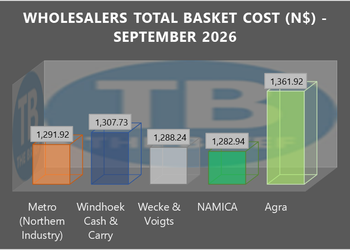
Bar chart of wholesale basket costs by wholesaler for Sept 2026 (N$).
Latest

NAMICA records lowest wholesaler basket in September 2026

October 11, 2026
Group of officials and community members standing on a highway, cutting a red ribbon to open a new road.
Latest

Germany finances N$372.6m of Karibib-Usakos road upgrade

October 9, 2026
Four professionals pose and smile for a group photo on a stage in front of a large 'Soft Skills' banner at a conference event.
Latest

Technical skills alone not enough for career growth, young professionals told

October 8, 2026
Namibia fuel prices set to drop in June
Latest

Fuel costs push Namibia’s inflation to 5.4% in September

October 8, 2026
Construction worker mixes wet concrete in a wheelbarrow on a damp tile surface, with a cement bag nearby and a concrete mixer in the background.
Latest

CIF demands fresh scrutiny if Whale Rock-Ohorongo deal returns

October 8, 2026
Group of seven professionals in hard hats with shovels at a daytime groundbreaking ceremony on an orange dirt site, with a brick wall and vehicles in the background.
Latest

Pupkewitz Group breaks ground on bigger, modern Pupkewitz MegaBuild branch in Grootfontein

October 8, 2026
Load More

Related News

Professional headshot of a man in a dark suit and red tie against a white background.

NamPost appoints Willem Mouton as CEO

July 31, 2026
Namibian Chamber of Agriculture mooted

Namibian Chamber of Agriculture mooted

September 28, 2021
Repo rate raised 8 consecutive times

Repo rate raised 8 consecutive times

April 21, 2023

Browse by Category

  • Africa
  • Agriculture
  • Analysis
  • Business & Economy
  • Columnists
  • Companies
  • e-edition
  • Finance
  • Finance
  • Fisheries
  • Green Hydrogen
  • Health
  • Investing
  • Latest
  • Market
  • Mining & Energy
  • Namibia
  • namibia
  • News
  • Opinions
  • Property
  • Retail
  • Technology
  • Tourism
  • Trade
The Brief | Namibia's Leading Business & Financial News

The Brief is Namibia's leading daily business, finance and economic news publication.

CATEGORIES

  • Business & Economy
  • Companies
    • Agriculture
    • Finance
    • Fisheries
    • Health
    • Property
    • Retail
    • Technology
    • Tourism
    • Trade
  • e-edition
  • Finance
  • Green Hydrogen
  • Investing
  • Latest
  • Market
  • Mining & Energy
  • namibia
  • News
    • Africa
    • Namibia
  • Opinions
    • Analysis
    • Columnists

CONTACT US

Cell: +264814612969

Email: newsdesk@thebrief.com.na

© 2026 The Brief | All Rights Reserved. Namibian Business News, Current Affairs, Analysis and Commentary

Welcome Back!

Login to your account below

Forgotten Password?

Retrieve your password

Please enter your username or email address to reset your password.

Log In
No Result
View All Result
  • Home
  • Companies
  • Mining & Energy
  • Business & Economy
  • Opinions
    • Analysis
    • Columnists
  • Africa

© 2026 The Brief | All Rights Reserved. Namibian Business News, Current Affairs, Analysis and Commentary

This website uses cookies. By continuing to use this website you are giving consent to cookies being used. Visit our Privacy and Cookie Policy.