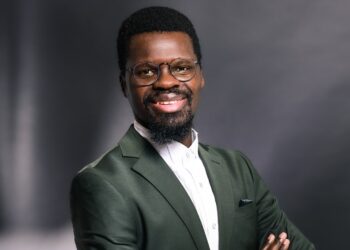
By Dr. Etuna Simon
A young Namibian sits with a smartphone in hand. With a few taps, she can watch a video produced in another country, ask an artificial intelligence (AI) system to explain a difficult concept, download an application developed thousands of kilometres away, play a game designed on another continent and scroll through digital content created for a global audience.
She is connected. She is digitally active. But there is another question we do not ask often enough: what can she create? Can she design an application that solves a problem in her community?
Can she build an AI tool that understands a Namibian language? Can she animate a story rooted in our culture? Can she analyse local data, design a digital service, develop software or turn an idea into a technology business?
That distinction matters. For years, the digital education conversation has understandably concentrated on access.
We wanted more schools connected, more learners exposed to computers, more students able to navigate the internet and more teachers comfortable using technology.
Those priorities remain important. But access can no longer be the destination. The next phase of Namibia’s digital education journey must be about moving our young people from consumers of technology to creators with technology.
Digital literacy is changing
Knowing how to use a computer was once considered a significant digital skill. Today, that definition is becoming too narrow.
Artificial intelligence can write text, generate images, analyse data, produce computer code and assist with design. Digital platforms have lowered the barriers to publishing, entrepreneurship and global collaboration.
Someone with the right skills can create a product in Namibia and potentially serve a market far beyond our borders.
Education must respond to that reality. A digitally literate learner should increasingly be able to do more than operate software.
The learner should understand how digital systems work, how information is produced, how AI should be questioned and how technology can be used to solve problems.
Coding matters, but this is bigger than coding. It is about computational thinking, creativity, design, problem-solving, data literacy, digital entrepreneurship and the confidence to move from asking, “Which application can I use?” to asking, What can I build?
A timely signal from Aus
This conversation became particularly relevant with the recent launch of the ǂKhai re National Digital Scholarship Programme in Aus.
The programme aims to train about 1,000 Namibians annually in information and communication technology over five years, with additional emphasis on women in technology and youth-focused technical training.
At its launch, Information and Communication Technology Minister, Hon. Emma Theofelus made an observation that deserves attention far beyond the technology sector.
Namibia, she argued, needs to grow a pool of people capable of building solutions for Namibia. That is an educational challenge as much as it is a digital one.
Training people to use technologies developed elsewhere will not, on its own, build a digital economy. Someone must eventually design the systems. Someone must develop the applications.
Someone must build the businesses. Someone must produce the local content. And increasingly, someone must understand artificial intelligence well enough not only to use it, but to adapt, interrogate and eventually create technologies appropriate to our circumstances. Education is where that capacity must begin.
Schools must create, not merely connect
Namibia has already started laying some of this foundation. The Youth Coding Initiative has introduced learners and teachers to coding and artificial intelligence, with UNESCO reporting that its first phase reached more than 3,000 young people and 350 teachers. Its second phase is intended to deepen the integration of coding and AI into education.
Our Sixth National Development Plan also calls for digital literacy and AI awareness among teachers and learners. Namibia’s National Digital Strategy goes further, envisioning computer programming and data science as part of curriculum reform.
These are important signals. But curriculum reform should not become another exercise in adding new terminology to a syllabus. A learner does not become an innovator merely because the words “coding”, “robotics” or “artificial intelligence” appear in a curriculum document.
Learners must build things. They must experiment, fail, redesign and try again. They should be challenged to identify problems in their communities and explore how technology could address them.
Imagine learners developing simple systems for monitoring water use, producing digital learning resources in local languages, creating applications around agriculture, designing educational games or using data to understand environmental challenges in their regions. That is when digital education becomes more than computer literacy. It becomes problem-solving education.
Creation is bigger than computer science
We should also resist the temptation to define the digital economy only through programmers and engineers. Creation takes many forms. The Namibia University of Science and Technology is expanding its work in digital arts and animation, with plans for degree programmes in areas including digital arts, animation, film and television. Its existing short-course offerings already include animation, filmmaking, scriptwriting and related digital creative skills.
This matters because Namibia is not only a consumer of foreign software. We are also consumers of foreign stories, animations, games, films and digital culture. Our children grow up watching characters created elsewhere, hearing stories situated elsewhere and navigating virtual worlds designed through other cultural lenses. There is nothing inherently wrong with global content. But where are our own digital stories?
Where are the animated characters speaking our languages? Where are the games built around our history, landscapes and communities? Where are the educational technologies designed from the perspective of a learner in Katima Mulilo, Opuwo, Keetmanshoop or Eenhana?
A digital creator is not only someone who writes code. It may be an animator, filmmaker, teacher, designer, researcher, entrepreneur or storyteller who understands how technology can transform an idea into something others can experience. That is why the arts belong in our digital education conversation too.
AI makes creativity more important, not less
There is an irony in the current technological moment. As AI becomes capable of doing more, we could easily conclude that people need to know less. I believe the opposite is true. When machines can generate content quickly, human value increasingly lies in knowing what should be created, why it matters, whether it is accurate and whom it serves.
AI can generate computer code, but someone must identify the problem worth solving. It can produce an image, but someone must understand the culture being represented. It can analyse information, but someone must recognise when its conclusions are misleading. It can help develop a product, but someone must understand the community for whom that product is being designed.
This changes what we should expect from education. We need young people who can work with AI without surrendering creativity, judgement and ownership of ideas to it. The future creator may work alongside intelligent machines. But the purpose, context and responsibility must remain human.
Teachers are central to this transition
None of this happens simply because learners receive devices. A school can have computers and still produce mainly digital consumers. The difference is pedagogy. Teachers need opportunities to develop their own confidence in coding, AI, digital design and project-based learning. They also need time, infrastructure and support to redesign learning experiences around investigation and creation.
This is especially important because digital inequality is not only about access to devices or connectivity. There is also a creation divide. Some learners encounter technology as something they can manipulate, build with and experiment on. Others encounter it primarily as something they watch, scroll through or use to complete tasks.
If we are not careful, that difference will eventually become an economic divide.
Access was only the beginning
Namibia should continue expanding connectivity, devices and digital infrastructure. NDP6 sets ambitious targets for increased access to technology and internet use by 2030. But we should be equally ambitious about what citizens are able to do once they are connected.
Perhaps the next measure of digital inclusion should not simply be how many young people can access the internet. We should ask how many can build something because of that access. How many can write code? How many can create digital businesses? How many can produce local digital content? How many can develop technology around Namibian problems? How many can use AI not simply to generate answers, but to turn their own ideas into solutions?
The young Namibian holding a smartphone is already connected to the digital world. Our next educational responsibility is to ensure that she does not spend her future only consuming what that world creates. She should be equipped to shape it. Because the strongest digital economy will not be built by a generation that merely knows how to use technology. It will be built by a generation that knows how to imagine, question and create with it.
Dr. Etuna Simon is a researcher, strategist and writer with a keen interest in education, innovation, artificial intelligence and national development. The views expressed in this article are solely those of the author. She can be reached at etunasimon@icloud.com