By Simeon Tuyoleni
On 4 November 2026 at Farm 58 outside Walvis Bay, President Netumbo Nandi-Ndaitwah, Alhaji Aliko Dangote and Dr George Elombi of Afreximbank stood up one after the other at the groundbreaking of the Dangote tank farm and regional pipeline, and if you listened to what they said you would have heard that none of them was talking about a lack of money, they were talking about us.
The president said it straight. “Africa people cannot remain poor when Africa has its own resources.” That is the whole thing in one line.
Let us start with the money, because that is always our first excuse. Dr Elombi told the room that his bank has put 10 billion dollars on the table for Dangote, and he said they have no difficulty doing it because “the money would not be lost.” And he was clear about what was missing. “The money is there. We don’t have the expertise.” He even refused to be called a foreign bank. “We are a domestic bank. We belong to you,” he said, and he asked the president to take them into the room with the central bank governor and the ministers and “tell us where it pains, where it hurts.”
So the money is sitting there, it is our money, and it is waiting for us to tell it where it hurts.
Then skills, our second excuse. The president said that initially there was a programme of capacity and skills, “but Africans, you go to same universities, you read the same books that other continents are reading. So we should just make use of that.”
Then our favourite excuse, waiting for someone to come and do it for us. Dangote said “Africa must industrialise Africa,” and when he comes into an African country, “we are coming home. We are not coming to make money and take the money away.”
So if it is not money, not skills and nobody is coming, what is it? Dr Elombi answered it himself. Conviction, trust and execution.
On conviction, the president said “no one can respect you as beggars,” and “unless we feed ourselves, they will continue to keep us hostage.” Dr Elombi said that if Dangote was doing this for profit, “he would not be in business again, he would be retired and enjoying the fruits.” He keeps going because he feels a duty to this continent.
On trust, Dangote said that in almost fifty years of business it is “the one element that is non-negotiable for me,” and that “money follows trust.” Dr Elombi said Dangote is the kind of client “you give the money to and you go to sleep,” you do not even need a recovery unit.
But it was the president who showed us why trust is not a soft thing. She took us back to our own story. After the Germans were defeated, the League of Nations put Namibia under a trust and gave South Africa the job of administering it until Namibians could take over. South Africa betrayed that trust, and what followed was a war between that administration and the Namibian people.
Then she said what I think every Namibian institution should put on its wall. “In any institutions where you are working and there’s no trust, one day the danger will come. You might celebrate it at the initial stage but it will come out and it will be very difficult to control.”
And on execution, she told us about investors who wanted to build a shipyard in Namibia. “After four years, they have to withdraw.” That pained her more than any other loss, so with Dangote she said “I must sit on this project,” put it in the Office of the President and it went from first meeting to groundbreaking in slightly over a year. She told us she had stopped going to groundbreakings, because “more than 10 years can pass without seeing the dust getting out of the ground,” and that she accepted this one because of the trust and confidence she has in the Dangote group. And she warned, “if we move slow, our people will continue to languish in poverty.”
That is not a lack of means. That is a choice, and we make it every day we let a file sit on a desk, every time we do not trust the person across the table, and every time we wait for somebody else to come and do what we already have the money and the brains to do ourselves.
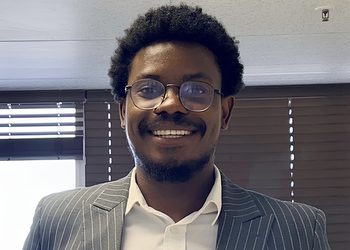
*Simeon Tuyoleni is a software engineer and founder of Asmbly, where we bring together the teachers, learners, and the schools to improve the quality of education in Namibia and beyond.