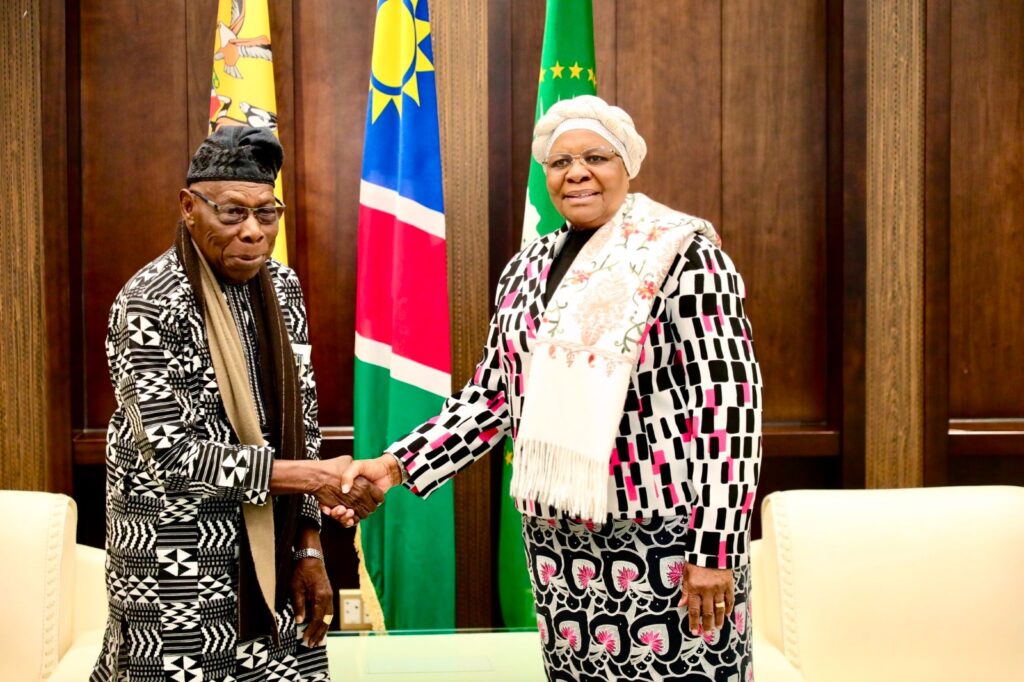
President Netumbo Nandi-Ndaitwah has held talks with former Nigerian President Olusegun Obasanjo in Windhoek, with discussions focusing on strengthening trade and investment ties between Namibia and Nigeria, as well as advancing broader African economic cooperation.
The courtesy visit follows previous engagements between the two leaders earlier this year and comes amid growing calls for African countries to mobilise domestic capital to finance development and reduce reliance on external funding.
Speaking after the meeting, Obasanjo said the discussions covered economic cooperation, regional developments and global geopolitical challenges affecting the continent.
“And then, of course, look at our region and our continent and a little bit of our world because the world that we are in now is far from the world that we expect to be in,” he said.
Obasanjo said ongoing engagement among African leaders was critical in addressing economic and security challenges facing the continent.
“But definitely we have to survive. We have to, we have to. And that is why this constant engagement is very necessary so that we see how best we can save our people,” he said.
According to Obasanjo, the visit was partly intended to provide feedback on issues discussed during his previous visit to Namibia about three months ago.
“When I was here about three months ago, and you are absolutely right, the president and I discussed a number of issues. And I said, I will come back,” he said.
He added that he had since examined the matters raised and returned to update President Nandi-Ndaitwah on progress made.
“So I went. The issue that we discussed, I looked into them. And if you like, what I have come to do now is to report back what in military terms we call a situational report, or SITREP,” he said.
A key theme of the discussions was the mobilisation of African capital to support investment and economic growth across the continent.
Obasanjo argued that African countries often underestimate their own financial capacity and pointed to significant resources held within sovereign wealth funds, pension funds, reserves and other institutional investment vehicles.
“We underrate our own capacity within Africa. I think that is the first thing I would say. We underrate our own capacity within Africa,” he said.
He estimated that Africa could mobilise as much as US$4 trillion from internal sources.
“What I understand is about four trillion dollars, four trillion American dollars. That is the money that we can mobilise within Africa from sovereign wealth fund, from reserve, from contributory pension fund, from health fund,” he said.
Obasanjo also maintained that Africa remains one of the most attractive destinations for investors seeking strong returns.
“Africa is still the place where you can get the highest return on investment. And if you are in business, you want the highest return on your investment,” he said.
However, he stressed that attracting and retaining investment requires stable and predictable policy environments.
“The only thing that we have to make sure is that we create conducive environment for money to come into Africa. Money is out there. Let’s create conducive environment for the money to come and to invest and to stay,” he said.
Obasanjo noted that Namibia already possesses several of the characteristics sought by investors, including political stability and predictability, which he said are essential for attracting long-term capital and supporting economic growth.