Sunday, September 20, 2026
Subscribe
The Brief | Namibia's Leading Business & Financial News
  • Home
  • Companies
    • Finance
    • Agriculture
    • Technology
    • Property
    • Trade
    • Tourism
  • Business & Economy
  • E-PAPERreader
  • Mining & Energy
  • Opinions
    • Analysis
    • Columnists
  • Africa
No Result
View All Result
The Brief | Namibia's Leading Business & Financial News
  • Home
  • Companies
    • Finance
    • Agriculture
    • Technology
    • Property
    • Trade
    • Tourism
  • Business & Economy
  • E-PAPERreader
  • Mining & Energy
  • Opinions
    • Analysis
    • Columnists
  • Africa
No Result
View All Result
The Brief | Namibia's Leading Business & Financial News
Subscribe
No Result
View All Result
Home Latest

Nandi-Ndaitwah pushes industry-focused education as NUST graduates 2,962

by reporter
May 8, 2026
in Latest
8
A A
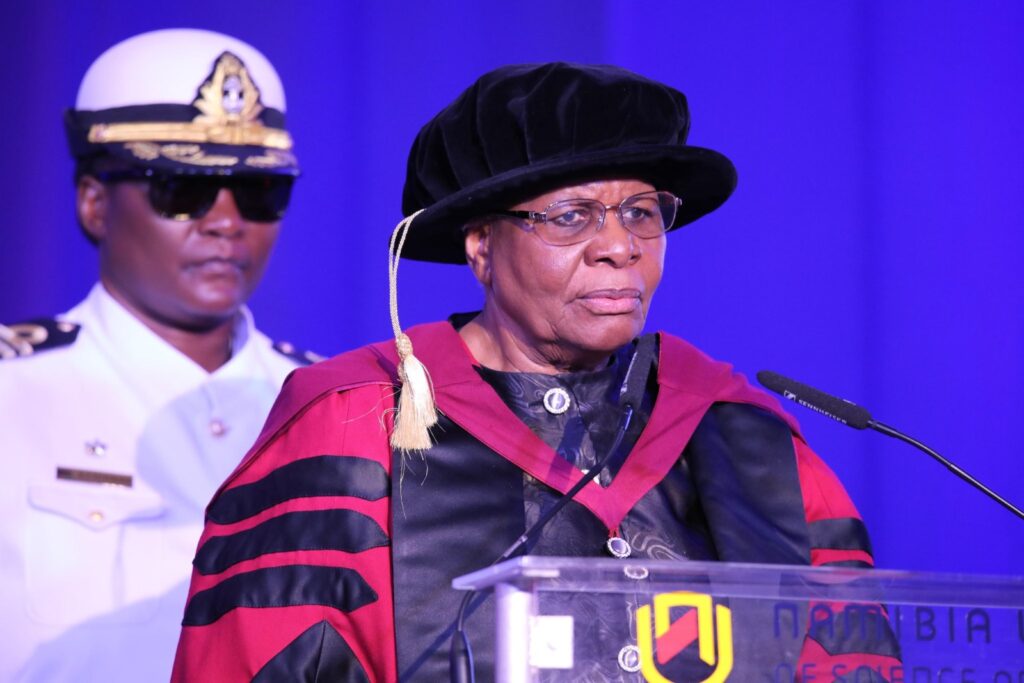
Woman in academic regalia speaks at a podium during a formal ceremony, a uniformed man stands behind her against a blue backdrop.

Netumbo Nandi-Ndaitwah has called for Namibia’s higher education system to be more closely aligned with industrialisation, entrepreneurship and job creation, warning that the country cannot build a competitive economy through theoretical education alone.

Speaking at the May 2026 graduation ceremony of the Namibia University of Science and Technology (NUST) in Windhoek on Friday, Nandi-Ndaitwah said institutions of higher learning must produce graduates equipped with practical and industry-relevant skills capable of driving economic transformation under Vision 2030 and the Sixth National Development Plan (NDP6).

The university graduated 2,962 students across various disciplines, including 164 master’s degree graduates and 13 doctoral candidates. The graduating class comprised 1,187 males and 1,775 females, while 132 international students also graduated.

Nandi-Ndaitwah said the gender imbalance among graduates remained a concern, particularly the lower participation of male students.

“However, what is disturbing is that those figures do not reflect the female-to-male population ratio of 51.2% and 48.8%, respectively. The message is clear: we must take the issue of the boy child seriously if we are to strengthen our social fibre and economic advancement,” she said.

The president said government views education and skills development as central to Namibia’s industrialisation strategy and long-term economic growth.

She said institutions such as NUST have become increasingly important in supplying technical skills and applied research needed to support value addition, innovation and employment creation.

“As Namibia prepares for a knowledge-based economy in a rapidly evolving global landscape, I am encouraged by the transformative role of institutions like NUST. NUST stands out as one of the hubs of innovation and applied research, producing graduates equipped with practical skills essential for industrial growth, entrepreneurship, and sustainable development,” Nandi-Ndaitwah said.

She highlighted specialised programmes in areas such as emergency medical care, medical laboratory science and vocational trainer development as examples of industry-linked education required to support economic expansion.

The president said government had expanded access to tertiary education funding through the Subsidised Tertiary Education Funding Model covering students at public and private institutions, as well as vocational training centres.

She added that the income threshold for non-tuition financial assistance had been increased to N$300,000 to broaden access for middle-income households.

Despite progress in higher education access, Nandi-Ndaitwah acknowledged persistent challenges including youth unemployment, skills mismatches and limited workplace opportunities for graduates.

She said government offices, ministries and agencies had been directed to allocate funding towards internships and apprenticeship programmes aimed at improving graduate employability.

“I urge all institutions of higher learning not to graduate students equipped only with theoretical classroom knowledge, without first-hand practical exposure to actual industry experience. Practical education in the real work environment should supplement the education content received in the classroom,” she said.

Nandi-Ndaitwah also called on the private sector to strengthen partnerships with universities and support workforce development initiatives.

She said Namibia’s future competitiveness would depend on its ability to integrate education, science, technology and innovation into broader economic development.

“In this new era, it is through knowledge that we will build resilient food systems, create industries, design technologies, grow businesses, improve public services, and develop innovative solutions that respond to the needs of our people,” she said.


author avatar
reporter
See Full Bio
Previous Post

FlyNamibia says Airlink partnership continues despite shareholder exit

Next Post

NCCI pushes for faster reforms to improve Namibia’s business climate

Must Read

Person pushing a metal shopping cart filled with white and green plastic bags in a store aisle
Latest

New Consumer Protection Agency planned to strengthen consumer rights in Namibia

September 18, 2026
Windhoek building approvals jump to N$145m in February
Latest

Windhoek building approvals fall to N$161.9 million in August

September 18, 2026
Toyota leads Namibia vehicle sales with over 50% market share
Latest

Toyota dominates Namibia vehicle market as August sales fall 10%

September 18, 2026
Why Humility Is the New Competitive Advantage in Leadership
Latest

If you don’t open your eyes, someone else will decide your path

September 18, 2026
White industrial complex with three garage bays and signs for AUAS MOTORS and GLASFIT under a clear blue sky.
Latest

Nictus targets airport rental fleets with new automotive service hub

September 17, 2026
ECB bans weekend power disconnections, introduces mandatory 24-hour notice
Latest

Amutse puts electrification agencies on notice over project delays

September 16, 2026
Load More

Related News

Namibia warned against exporting natural resources to avert energy crisis

Namibia warned against exporting natural resources to avert energy crisis

April 5, 2024
Navigating the future: Intergenerational governance in Namibia

Navigating the future: Intergenerational governance in Namibia

September 23, 2024
Meatco benefits from EU beef price spike

Meatco benefits from EU beef price spike

May 18, 2022

Browse by Category

  • Africa
  • Agriculture
  • Analysis
  • Business & Economy
  • Columnists
  • Companies
  • e-edition
  • Finance
  • Finance
  • Fisheries
  • Green Hydrogen
  • Health
  • Investing
  • Latest
  • Market
  • Mining & Energy
  • Namibia
  • namibia
  • News
  • Opinions
  • Property
  • Retail
  • Technology
  • Tourism
  • Trade
The Brief | Namibia's Leading Business & Financial News

The Brief is Namibia's leading daily business, finance and economic news publication.

CATEGORIES

  • Business & Economy
  • Companies
    • Agriculture
    • Finance
    • Fisheries
    • Health
    • Property
    • Retail
    • Technology
    • Tourism
    • Trade
  • e-edition
  • Finance
  • Green Hydrogen
  • Investing
  • Latest
  • Market
  • Mining & Energy
  • namibia
  • News
    • Africa
    • Namibia
  • Opinions
    • Analysis
    • Columnists

CONTACT US

Cell: +264814612969

Email: newsdesk@thebrief.com.na

© 2026 The Brief | All Rights Reserved. Namibian Business News, Current Affairs, Analysis and Commentary

Welcome Back!

Login to your account below

Forgotten Password?

Retrieve your password

Please enter your username or email address to reset your password.

Log In
No Result
View All Result
  • Home
  • Companies
  • Mining & Energy
  • Business & Economy
  • Opinions
    • Analysis
    • Columnists
  • Africa

© 2026 The Brief | All Rights Reserved. Namibian Business News, Current Affairs, Analysis and Commentary

This website uses cookies. By continuing to use this website you are giving consent to cookies being used. Visit our Privacy and Cookie Policy.