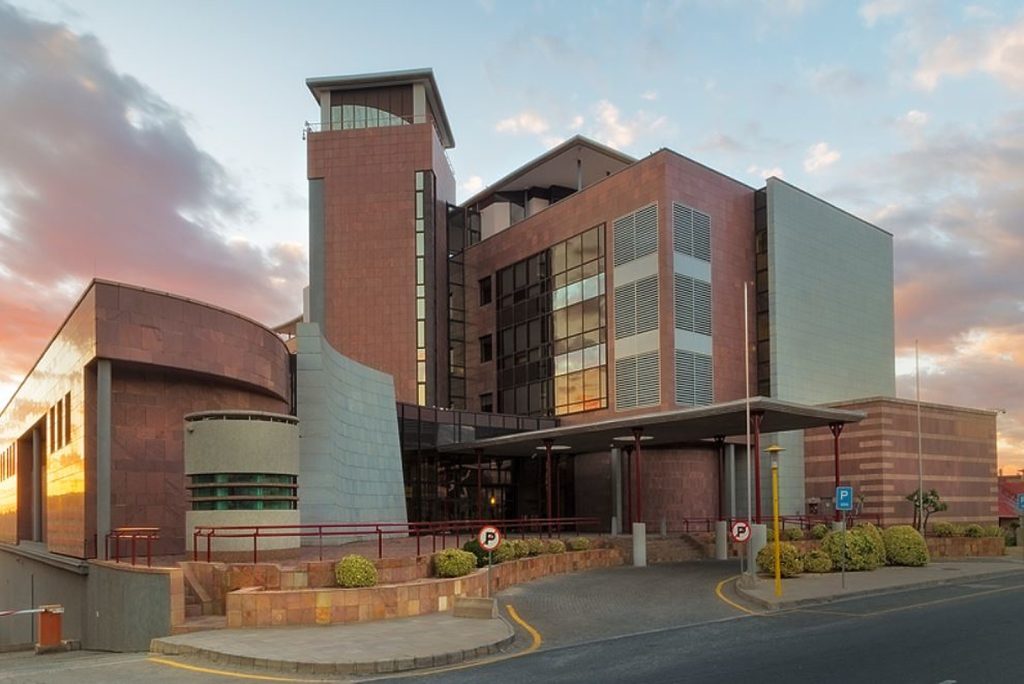
Bank of Namibia Deputy Governor Leonie Dunn has warned that rising inflation risks and global uncertainty could force revisions to Namibia’s economic outlook.
“These dynamics present a material risk to the current forecast and may necessitate major revisions,” she said.
Dunn pointed to oil price volatility and geopolitical developments as key external pressures likely to push inflation higher, particularly following domestic fuel price increases implemented in April 2026.
She also highlighted regional risks, including Foot-and-Mouth Disease outbreaks, which could weigh on agricultural output and exports.
Despite these pressures, Dunn said the domestic economy is expected to recover over the medium term, supported by growth in construction, utilities and public sector investment.
However, she stressed that long-term growth will depend on diversification, value addition and the development of new sectors.
“In such an environment, the role of institutions, particularly central banks, is not only to preserve stability, but to anticipate change, to build resilience, and to enable growth,” she said.
In response to the evolving economic landscape, she said the Bank of Namibia is advancing a series of financial sector reforms aimed at strengthening resilience and improving investor confidence.
These include the development of an Instant Payments Solution to enable real-time transactions and expand financial inclusion, as well as the rollout of a Central Securities Depository to improve efficiency in capital markets.
The central bank is also implementing a Gold Acquisition Programme to strengthen reserve adequacy amid ongoing global uncertainty.
“We are not insulated from global uncertainty, but we are not constrained by it either. As we look ahead, the Bank of Namibia is dedicated to building a financial system that is resilient, inclusive and future-ready,” Dunn said.
She added that these reforms are supported by improving macro-financial indicators, including the successful redemption of the US$750 million Eurobond in 2025 and the growth of the Welwitschia Sovereign Wealth Fund to US$30.09 million by February 2026.
Dunn said the central bank remains focused on aligning policy, strengthening institutional capacity and ensuring the financial system can respond effectively to both domestic and external shocks over the medium term.
This comes as the Bank of Namibia’s Economic Outlook for March 2026 projects moderate growth over the medium term, following slower expansion estimated for 2025.
The domestic economy is estimated to have grown by 1.7% in 2025 and is projected to expand by 2.6% in 2026 and 2.9% in 2027.
The central bank noted that, despite downward revisions compared to the December 2025 Economic Outlook update, growth in 2026 and 2027 remains moderate, supported mainly by expansion in the secondary and tertiary sectors, particularly construction, electricity and water, wholesale and retail trade, financial services, and public administration and defence.
Uranium mining is expected to remain a key contributor to growth within the primary industries, supported by increased production from existing operations.
The latest projections for 2026 and 2027 reflect a downward revision of 1.2 percentage points and 1.4 percentage points, respectively, compared to projections published in the December 2025 Economic Outlook update.
The downward revisions are largely attributed to weaker-than-expected performance in the primary industries, particularly a contraction in metal ores production and continued weakness in diamond mining.
Meanwhile, the bank’s Namibia Inflation Forecast Report shows that domestic inflation slowed to 2.9% in January 2026 but is expected to edge up to between 3.0% and 3.2% in early 2026. Medium-term projections place inflation at an average of 3.5% in 2026 and 3.4% in 2027, supported by softer oil prices and a stronger US dollar.