President Netumbo Nandi-Ndaitwah has urged G20 leaders to strengthen global debt treatment frameworks and expand concessional financing for countries demonstrating sound fiscal management, warning that rising debt-servicing costs are increasingly constraining development across Africa.
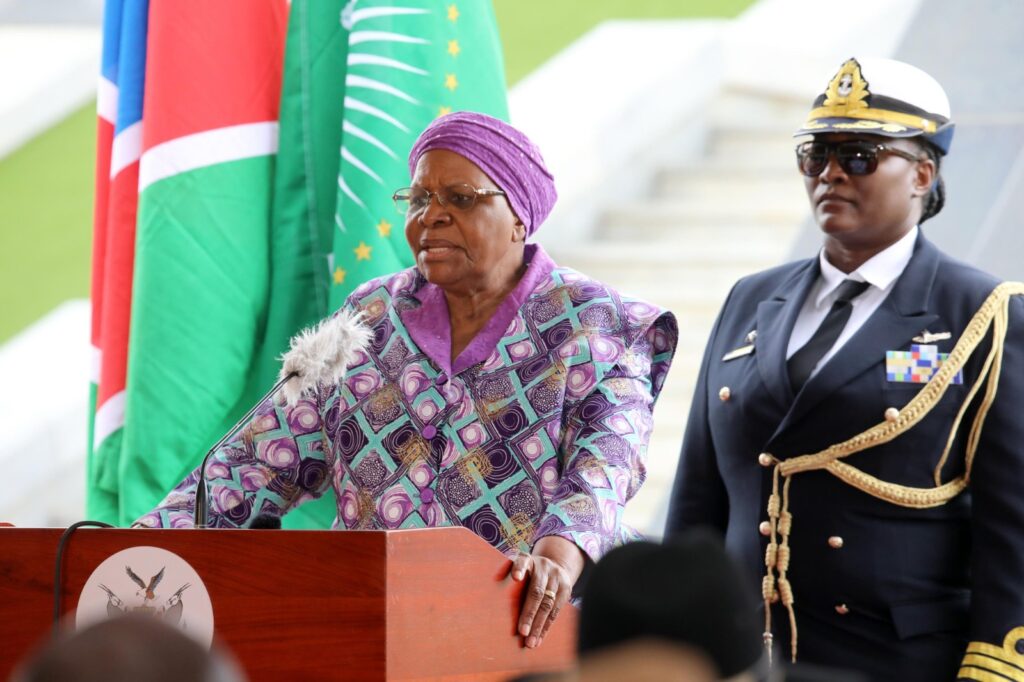
Delivering Namibia’s intervention during deliberations on the G20 report, the President said many African economies are facing mounting fiscal pressure as debt repayments crowd out spending on infrastructure, social services and economic transformation.
She said Namibia is calling for practical support through improved debt restructuring mechanisms and more affordable financing options for countries that pursue responsible borrowing and fiscal discipline.
“Namibia therefore urges G20 leaders to strengthen debt treatment frameworks and provide concessional financing to countries that demonstrate a commitment to sound debt management,” Nandi-Ndaitwah told delegates.
The President also congratulated South African President Cyril Ramaphosa and the South African government for hosting the African G20 Summit, commending the Leaders’ Declaration for placing Africa’s development priorities at the centre of global economic discussions.
She noted that the Declaration addressed key challenges facing the continent, including a just energy transition, debt sustainability for low-income countries, mineral exploration and local beneficiation, industrialisation, employment creation, inequality reduction and food security.
Nandi-Ndaitwah further welcomed efforts to deepen partnerships with Africa through the G20 Compact with Africa and strengthen the Finance Track’s focus on the continent.
“The approach the South African G20 Presidency took in calling for a strong Partnership for Africa through the G20 Compact with Africa and strengthening the Finance Track focus on Africa is a commendable initiative, and Namibia fully aligns with that vision,” she said.
Namibia also supports the African Union’s recommendation that the G20 Compact with Africa be aligned with the African Continental Free Trade Area (AfCFTA), with emphasis on promoting manufacturing, industrialisation and infrastructure corridors to advance regional integration.
The President welcomed two reports commissioned under South Africa’s G20 Presidency and endorsed recommendations that they be incorporated into the African Union’s repository on advancing multilateralism.
She also expressed support for South Africa’s intention to submit the report of the G20 Extraordinary Committee of Independent Experts on Global Inequality to the 80th United Nations General Assembly, saying the move would strengthen multilateral cooperation and amplify Africa’s voice in global economic governance.
The G20 is a major global forum representing the world’s largest economies and coordinates international action on financial stability, economic growth, trade, climate and development. The grouping accounts for roughly 85% of global GDP and includes 19 countries alongside the European Union and the African Union.
While Namibia is not a direct member, it participates through the African Union and regional representation via South Africa, the continent’s only individual G20 member. Decisions taken within the forum influence regional trade dynamics, debt frameworks, commodity markets and infrastructure financing, all of which shape economic conditions in Namibia and the broader Southern African region.