The Central Procurement Board of Namibia (CPBN), acting on behalf of the Namibia Water Corporation (NamWater), has awarded a N$191 million contract for the first phase of the Naute–Keetmanshoop Water Pipeline Replacement and Ancillary Works project.
NamWater’s Head of PR and Corporate Communications, Lot Ndamanomhata, said the project, fully funded by NamWater, marks a major step in upgrading water infrastructure in the south.
“Valued at N$191,041,427.93 (excluding VAT), the contract spans 18 months and marks the official commencement of Phase 1 of the Naute–Keetmanshoop Water Pipeline Replacement Project. The project is fully funded by NamWater. The contract was formally signed on 23 September 2025 by CPBN, NamWater, and the contractor, followed by the official site handover on 3 October 2025,” Ndamanomhata said.
The contract was signed with Adaptive Building Land Construction CC, a Namibian company, in joint venture with China State Engineering Corporation (Southern Africa) (Pty) Ltd Namibia. The project’s launch follows nearly two years of delay due to legal challenges from unsuccessful bidders.
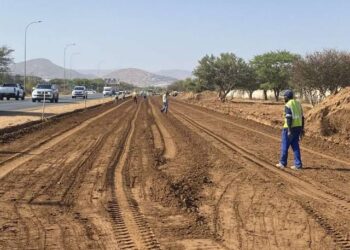
According to Ndamanomhata, Phase 1 of the project involves constructing a 36-kilometre clear-water pipeline parallel to the existing one, using 450 mm diameter Glass Reinforced Polyester (GRP) pipes. The new underground pipeline will ensure a safer and more reliable water supply for Keetmanshoop and surrounding communities.
He said NamWater’s Civil Engineering Department will oversee the design and supervision of the works, while the Programme Management Department will be responsible for project management.
“Beyond infrastructure improvement, the project is expected to create approximately 50 local jobs and stimulate economic activity in the //Kharas Region during implementation,” Ndamanomhata added.
Commissioned in 1972, the Naute–Keetmanshoop water supply scheme is one of Namibia’s main bulk water systems.
It sources water from the Naute Dam, located about 45 kilometres southwest of Keetmanshoop, and relies on a 43-kilometre steel pipeline that has deteriorated over time, leading to frequent leaks and bursts.