Namibia’s net foreign direct investment (FDI) inflows surged to N$12.6 billion in the fourth quarter of 2024, marking a significant increase from N$5.0 billion in the previous quarter.
According to the Bank of Namibia’s (BoN) latest quarterly bulletin, this was supported by activities in the Orange Basin.
“The quarterly growth was attributed to increased equity injections from oil exploration operators, as oil exploration activities mainly in the Orange Basin expanded with new operators coming on board,” the BoN stated.
Additionally, the central bank highlighted that the rise in FDI was further supported by intercompany loan uptake from companies in the mining and manufacturing sectors.
Despite the quarterly increase, FDI inflows declined by 13.7% on an annual basis due to reduced equity injections, lower intercompany borrowing, and a fall in the reinvestment of earnings.
This comes as net outflows on the services account decreased year-on-year but showed an increase from the third quarter of 2024.
“On an annual basis, the services account recorded a lower net outflow of N$6.8 billion in the current quarter, compared to an outflow of N$9.1 billion recorded a year earlier,” the BoN stated.
According to the central bank, this decline was due to decreased net payments for maintenance and repair services, as well as other business services, coupled with a net inflow in transport services.
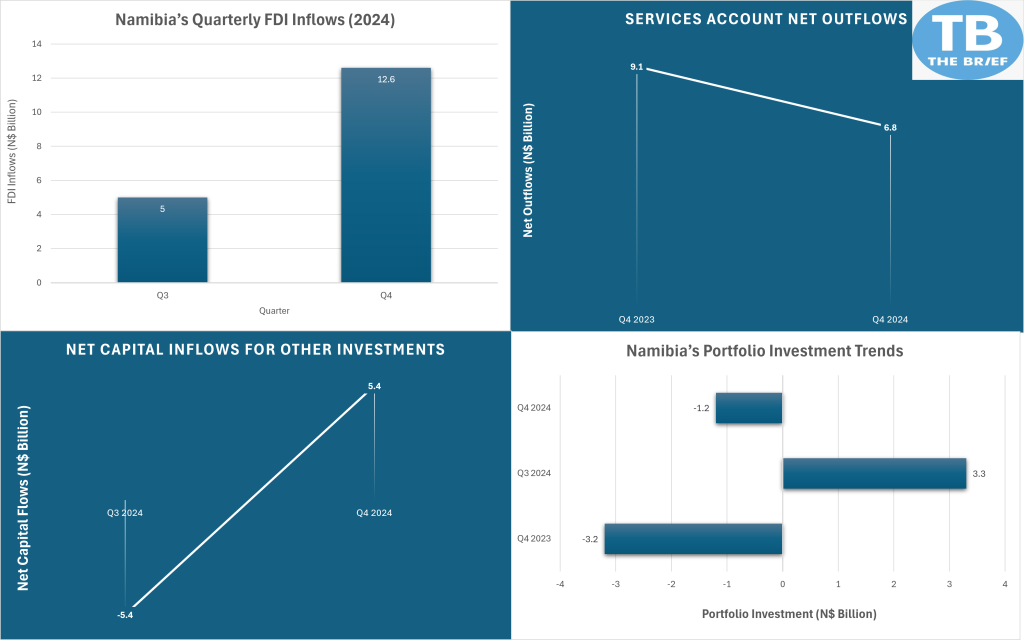
However, quarter-on-quarter, net outflows rose by N$4.6 billion to N$6.8 billion, mainly due to increased net payments for business services linked to heightened oil and gas exploration activity in the Orange Basin.
Meanwhile, Namibia’s portfolio investment switched from a net inflow to a net outflow during the quarter, driven by increased investments in equity and debt securities abroad.
“During the period under review, portfolio investment recorded a net outflow of N$1.2 billion, in contrast to the net capital inflows of N$3.3 billion in the previous quarter and a net outflow of N$3.2 billion in the same quarter of the previous year,” the BoN reported.
The quarterly shift from inflow to outflow was mainly fuelled by resident institutional investors increasing their holdings in money market instruments abroad.
Other investments recorded a net capital inflow of N$5.4 billion, reversing the net outflow observed in the previous quarter.
“The net inflow was on the back of higher foreign trade credit uptakes by resident companies in the mining and manufacturing sectors,” the BoN noted.
The central bank further attributed the inflows to a reduction in deposits abroad by resident commercial banks over the period under review.